
Healthcare · Waitlist open
Chiropractic answering service, answered 100% by AI
Short answer
A chiropractic answering service answers your clinic’s phone while you’re adjusting patients: it books new patient exams, moves adjustments and writes down the claim details your team needs for accident and work-injury cases. Ours is 100% AI and introduces itself that way; it never comments on an injury or on what insurance will pay. Each call reaches you as a short summary.
This is a phone-answering service for medical offices. It doesn’t give medical advice, and callers with an emergency are told to hang up and call 911.
No payment needed to join the waitlist.
Example call: a new patient after a car accident
Clark Fork Chiropractic · A new patient after a car accident
- AI
- Clark Fork Chiropractic, this is AI Receptionist, the clinic’s AI assistant. If this is a medical emergency, please hang up and call 911.
- Caller
- I was rear-ended last week. My lawyer said to call.
- AI
- I can book a new patient exam. Your name and number?
- Caller
- Kyle Brannigan, 555-0105.
- AI
- Thanks, Kyle. Any claim number?
- Caller
- Not with me.
- AI
- I have tomorrow at 9:15 or 4:30.
- Caller
- 4:30.
- AI
- You’re booked for tomorrow at 4:30.
Summary sent to you
- New patient, car accident
- Kyle Brannigan, 555-0105. Says his lawyer told him to call.
- Booked
- new patient exam, tomorrow at 4:30 p.m.
- To do
- get the auto claim number and attorney details before the visit.
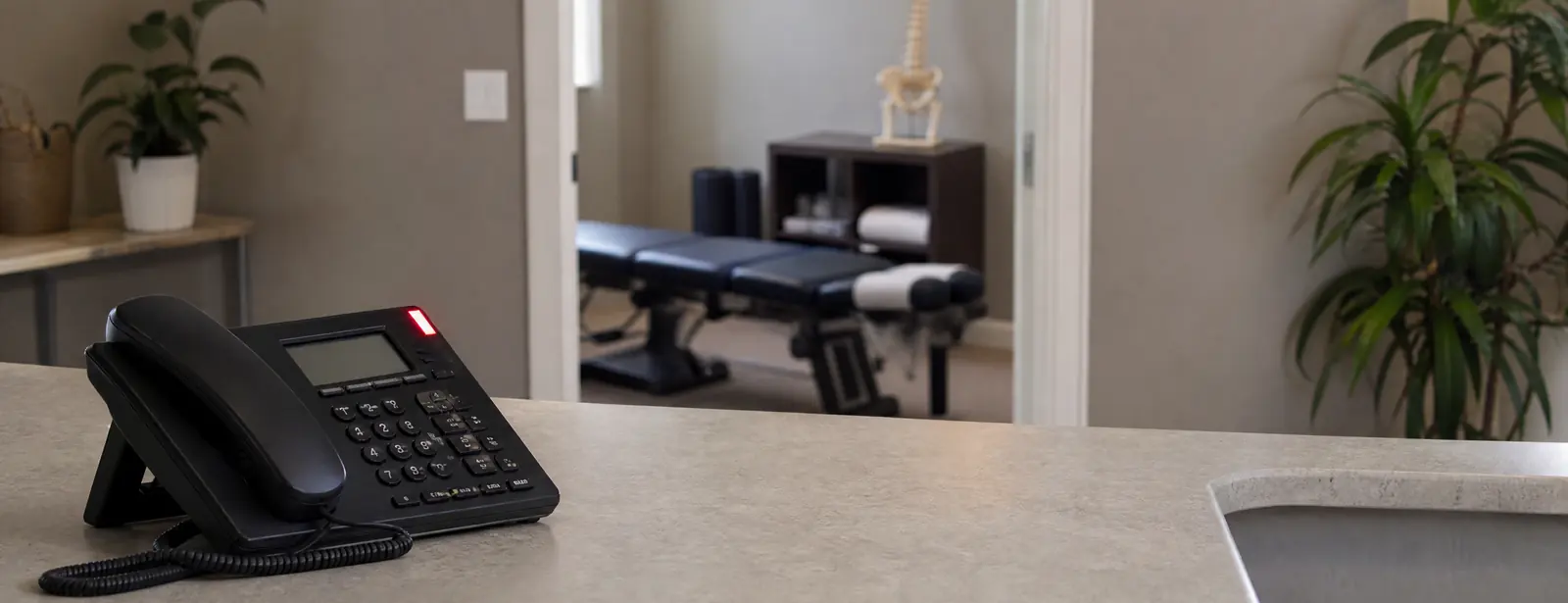
When chiropractic calls come at the wrong time
It’s 5:30 p.m. on a Wednesday at a chiropractic clinic in Missoula, the busiest hour of the week. The doctor is moving from table to table every twelve minutes, and the one person at the front desk is checking out a patient and taking a payment. The phone rings three times: a regular who needs to move Friday’s adjustment, someone asking about the new patient special they saw on a flyer, and a man who was rear-ended last week and whose lawyer told him to call. The last one is the most valuable call of the day, and it’s going to voicemail.
How the call goes
-
Answer as your clinic, with the 911 line
Your clinic’s name, that it’s an AI assistant, and the emergency line.
The AI says: “Clark Fork Chiropractic, this is AI Receptionist, the clinic’s AI assistant. If this is a medical emergency, please hang up and call 911.”
-
New or returning patient
Returning patients are found by name and phone; new patients get your new patient exam, which usually needs a longer slot.
The AI says: “Have you been to the clinic before, or is this your first visit?”
-
Is this an accident or work-injury case?
For new patients, it asks whether the visit is related to a car accident or a work injury, because those cases are billed differently. It writes down the claim number, the attorney or the employer if the caller has them, and leaves the rest to your team. It doesn’t ask what hurts.
The AI says: “Is this visit related to a car accident or an injury at work?”
-
Book the right slot
New patient exams, adjustments, or your walk-in hours if you have them. It confirms a visit only once it’s saved in your calendar; otherwise it stays pending for your team.
The AI says: “I have tomorrow at 9:15 or 4:30 for a new patient exam.”
-
Send you the summary
Every call ends with a summary in your inbox: who called, what was booked and what your team still has to do. After closing time, calls follow our after-hours triage protocol; other scripts are in the call protocol library.

What counts as urgent
The AI doesn’t judge an injury. It goes by what the caller says they need and by your rules.
| Situation | What happens |
|---|---|
| Caller says it’s an emergency, or that someone is hurt badly right now | Told to hang up and call 911 |
| New patient after a car accident | Booked into your new patient time; claim number and attorney noted for your team |
| Work-injury patient | Booked; employer and claim number noted, if the caller has them |
| Caller asks about your new patient offer | Reads the offer you approved, word for word, and books it |
| Regular patient moving or canceling an adjustment | Moved in your calendar; the freed slot is in the summary |
| Caller asks whether you take their insurance or Medicare | Message for your team to check; nothing promised on the call |
What it never says on these calls
- Whether chiropractic care will help the caller’s condition.
- Anything about the accident: who was at fault, what the claim is worth, what to tell an insurer or a lawyer.
- Whether insurance or Medicare will cover the visits.
- A price, unless it’s your approved new patient offer or fee, read as you wrote it.
- How many visits the caller will need.
What you decide
- Your visit types: new patient exam length, adjustment slots and walk-in hours.
- Accident and work-injury cases: whether you take them and what details the AI writes down.
- Your new patient offer: the exact words it reads, or none.
- Insurance and Medicare: what it says about the plans you accept, or a message every time.
- Who gets the summaries: you, your front desk or both.
We set it up the way you want and you approve the final version.
Why this works for chiropractic clinics
Our call protocols come from nearly two decades of running phone reception for small businesses. Two rules of that method fit a chiropractic clinic exactly. It asks what matters: accident or work injury comes before the time slot, because it changes the paperwork. It never promises what you don’t: no “this will fix your back,” no “your insurance covers it.” The full method is on our method.
What it costs
Each call is billed once, whether it’s a two-line reschedule or a new accident patient spelling out an attorney’s name. We charge per answered call, never per minute, with no contract. A clinic’s rate is agreed with you when we reach chiropractors on the waitlist; current plans for other businesses are on pricing.
Questions chiropractors ask
What does a chiropractic answering service handle?
A chiropractor answering service takes new patient calls, rescheduled adjustments, questions about your hours and your new patient offer, and accident or work-injury cases with the claim details written down. It answers while you’re with patients, after hours and on weekends, and sends a summary of each call.
Is an AI receptionist for a chiropractor better than voicemail?
For new patients, usually. Many people won’t leave a message for a clinic they haven’t visited; they call the next one. An AI receptionist answers on the first ring, books the exam and leaves you the details, so the call becomes a visit instead of a missed call.
How is this different from virtual receptionists for chiropractic clinics?
A virtual receptionist service usually means a person answering remotely, paid by the minute or by the hour. Ours is an AI: it answers several calls at the same time, day and night, follows your script exactly and bills per answered call. If a call needs you, it’s transferred to you by your rules, explained on call transfer.
Can it book personal injury patients?
Yes, if you take them. It asks whether the visit follows a car accident, notes the claim number and the attorney if the caller has them, and books the new patient exam. It doesn’t discuss the accident, the injury or the claim; that’s for your team. Healthcare practices join through the waitlist for now, because a Business Associate Agreement (BAA) isn’t signed yet.
Does an answering service for chiropractors cost more than hiring front desk help?
It’s billed a different way: by the answered call, not by the hour, so a quiet Tuesday costs little and the 5:30 rush costs no overtime. A person at the desk takes one call at a time; the AI takes all three. Our rate for clinics is set from the waitlist, and the general plans are on pricing.
Join the healthcare waitlist
Leave your details in the healthcare waitlist form on this page, and tell us whether you see accident and work-injury patients. When we can set up your clinic, we write the protocol around your new patient exam and your claim details, and you approve it before it answers; the steps are on how it works. Other practices are on healthcare, including physical therapy clinics.
Free to join · No commitment