
Healthcare · Waitlist open
Dental answering service: an AI receptionist for dental offices
Short answer
A dental answering service answers your office’s phone when your team is chairside or the office is closed: it books new patients, moves cleanings, takes messages and reaches your on-call dentist when a caller asks. Ours is 100% AI, which it tells every caller up front, and it never comments on a tooth or on what insurance will pay. You get a summary of every call, with the open and filled slots in it.
This is a phone-answering service for medical offices. It doesn’t give medical advice, and callers with an emergency are told to hang up and call 911.
No payment needed to join the waitlist.
Example call: a new patient booking a cleaning
Portage Street Dental · A new patient booking a cleaning
- AI
- Portage Street Dental, this is AI Receptionist, the office’s AI assistant. If this is a medical emergency, please hang up and call 911.
- Caller
- Hi, I’m new in town and I need a cleaning.
- AI
- Your name and best number?
- Caller
- Simone Osei, 555-0106.
- AI
- Thanks, Simone. Will you be using dental insurance?
- Caller
- Yes, through work.
- AI
- Noted for the office. I have Wednesday at 3:30.
- Caller
- Perfect.
- AI
- You’re booked: new patient cleaning and exam, Wednesday at 3:30.
Summary sent to you
- New patient
- Simone Osei, 555-0106.
- Booked
- new patient cleaning and exam, Wednesday at 3:30 p.m.
- To do
- check her insurance through her employer before the visit.
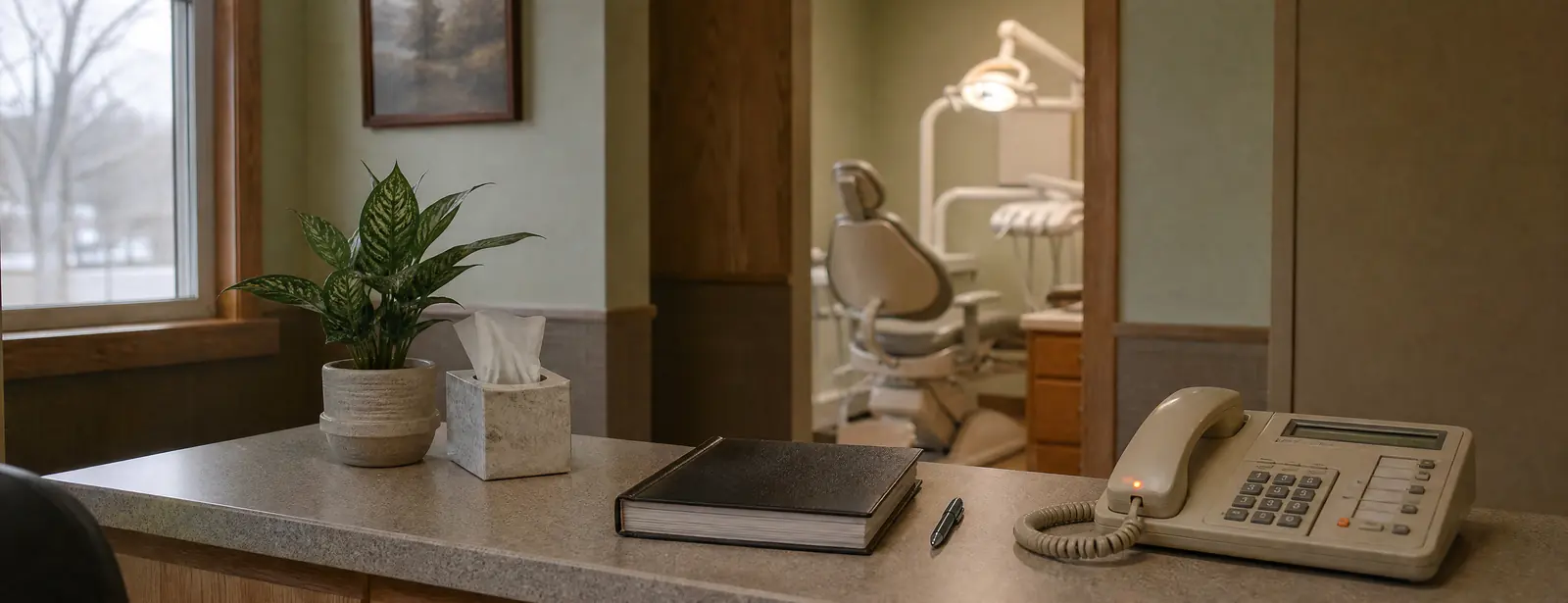
When dental calls come at the wrong time
Tuesday, 10:15 a.m., at a two-dentist practice in Kalamazoo. Both dentists are mid-procedure, the hygienist is halfway through a cleaning, and the one person at the front desk has been on hold with an insurance company for twenty minutes. The phone rings four times. One caller is a new patient who found the office online and won’t leave a voicemail; she’ll try the next practice on the list. Saturday is the same, with the office closed and people asking whether anyone can see them Monday. Each of those calls is a chair that could have been filled.
How the call goes
-
Answer as your office, with the 911 line
Your office name, that it’s an AI assistant, and the emergency line.
The AI says: “Portage Street Dental, this is AI Receptionist, the office’s AI assistant. If this is a medical emergency, please hang up and call 911.”
-
New patient or patient of the practice
New patients get your new patient visit; existing patients are found by name and phone so the visit goes in their record.
The AI says: “Have you been to our office before, or would this be your first visit?”
-
What kind of visit
It uses your own appointment types: a cleaning and checkup, a visit for a specific problem, a cosmetic or orthodontic consultation. It doesn’t ask about symptoms; the type of visit is enough to find the right slot.
The AI says: “Is this for a cleaning and checkup, or a visit about a specific problem?”
-
Insurance, noted, never promised
It writes down whether the caller has dental insurance and, if they offer it, the plan name, so your team can check benefits before the visit. It never says what’s covered.
The AI says: “I’ll note that so the office can check your plan before you come in.”
-
Book, or pass it on
It books the slot in your calendar and confirms only once it’s saved. If the caller asks for your same-day slot or for the on-call dentist, it follows your rules. Nights and weekends follow our after-hours triage protocol.

What counts as urgent
The AI doesn’t decide whether a tooth can wait. It offers what you’ve set up when the caller asks for it.
| Situation | What happens |
|---|---|
| Caller says it’s a medical emergency | Told to hang up and call 911 |
| Caller asks to be seen today | Booked into the same-day slots you hold back, if one is open; otherwise your line for urgent cases: the on-call dentist, your emergency referral or a message for first thing, as you set it |
| After hours, caller asks for the on-call dentist | Put through, or the dentist is alerted, per your on-call rules |
| Patient cancels or moves a cleaning | Moved in your calendar; the freed slot is in the summary |
| Orthodontic patient asks for an adjustment or repair visit | Booked in the orthodontic schedule, or a message for the office |
| Billing, statements or records | Message for the office, with a callback number |
What it never says on these calls
- Whether insurance covers a visit or what the patient will owe.
- Whether a problem sounds serious, can wait or needs a specific treatment.
- Advice about pain, medication or what to do at home.
- A treatment price, unless it’s one you’ve approved word for word, like a new patient offer.
- “The dentist will see you today,” unless the slot is booked.
What you decide
- Your appointment types: which ones it books, for which dentist or hygienist, and how long each takes.
- Same-day slots: how many you hold back and who can have them.
- Your on-call dentist: who covers nights and weekends, and how they’re reached.
- What it says about insurance and fees: the plans you accept, a new patient offer, or nothing at all.
- Orthodontic rules: separate schedule, adjustment visits, what goes to the office as a message.
- Who gets each summary: the front desk, the office manager or both.
We set it up the way you want and you approve the final version.
Why this works for dental offices
Our call protocols come from nearly two decades of running phone reception for small businesses. On a dental line, two rules matter most. It asks what matters: new or existing patient and the type of visit come first, because they decide the slot. It never promises what you don’t: coverage and treatment are your team’s to discuss, never the phone’s. More on our method and on how visits are booked on appointment scheduling.
What it costs
A new patient who calls on a Saturday morning and books a cleaning is one answered call, however long the insurance questions take: we never bill by the minute, and there’s no contract. The rate for a dental office is agreed with you once your practice comes off the waitlist. The plans other businesses use today are on pricing.
Questions dental office owners ask
What does a dental answering service do?
A dentist answering service answers when your front desk can’t: it books new patients and cleanings, moves and cancels visits, takes messages about billing or records and reaches your on-call dentist when a caller asks. Every call ends with a summary in your inbox. Ours is an AI receptionist, so several callers can be answered at the same time.
Is an AI dental receptionist different from a dental virtual receptionist?
A dental virtual receptionist is usually a person answering from a remote office, and you pay for their time. An AI dental receptionist is software that talks with the caller and books the visit in your calendar. Both answer your line; the AI answers every call on the first ring, day and night.
Can it work with our scheduling software?
It books in your calendar; how it connects to the tools you already use is set up with you before the first call. If a booking can’t be saved, the AI tells the caller the office will confirm, and the request reaches you as pending instead of being lost.
Does it work for orthodontic practices?
Yes. An AI receptionist for orthodontics books consultations, adjustment visits and repair visits in a separate schedule if you keep one. If a caller describes a problem with braces or an aligner, it doesn’t judge it: it offers your repair visit or takes a message for the office.
What happens with dental emergencies after hours?
The 911 line comes first. If the caller asks for the on-call dentist, the call is put through or the dentist is alerted, as you set it. If not, it books the first urgent slot you hold for the morning, or takes a message, as you set it. How nights work is on after-hours medical answering.
Join the healthcare waitlist
Why the waitlist: a dental office needs a business associate agreement with any service that handles its calls, and ours isn’t signed yet; what that means is in our guide to HIPAA and answering services. Tell us how many dentists and hygienists you schedule in the waitlist form on this page. When we can set up your office, we build the protocol around your appointment types, and nothing answers a patient until you approve it. The setup steps are on how it works, and other practices we answer for, such as medical offices, are on healthcare.
Free to join · No commitment