
Home services
HVAC answering service for the first cold morning and the first heat wave
Short answer
An HVAC answering service answers your heating and cooling calls when your team can’t. Ours is 100% AI: it answers under your company name, introduces itself as an AI and asks what a good dispatcher asks: whether the system is off or just weak and whether anyone at home is at risk. Real no-heat and no-cooling emergencies reach your on-call technician, maintenance-plan customers get the priority you promised them, and everyone else is booked. You get a summary of every call, even on the busiest morning of the season.
Free setup · No contract · Cancel anytime
Example call: a plan member’s furnace on a cold morning
Prairie Wind Heating & Cooling · A plan member’s furnace on a cold morning
- AI
- Prairie Wind Heating & Cooling, this is AI Receptionist, the AI assistant. How can I help?
- Caller
- Our furnace won’t come on. It’s 58 in here.
- AI
- Any gas smell, and is anyone home elderly or unwell?
- Caller
- No. Just me and my husband.
- AI
- Are you on a maintenance plan?
- Caller
- Yes, under Pennington.
- AI
- Plan members get our priority slot. Ten to noon is open. Address and number?
- Caller
- 418 Goldenrod Drive, 555-0132.
- AI
- You’re booked for ten to noon.
Summary sent to you
- Priority
- furnace not heating, 58°F indoors. No gas smell, nobody at risk.
- Caller
- Gloria Pennington, 418 Goldenrod Drive, 555-0132. Says she’s on a maintenance plan; check the account.
- Done
- booked today, 10 a.m. to noon, in your priority slot. No price given.
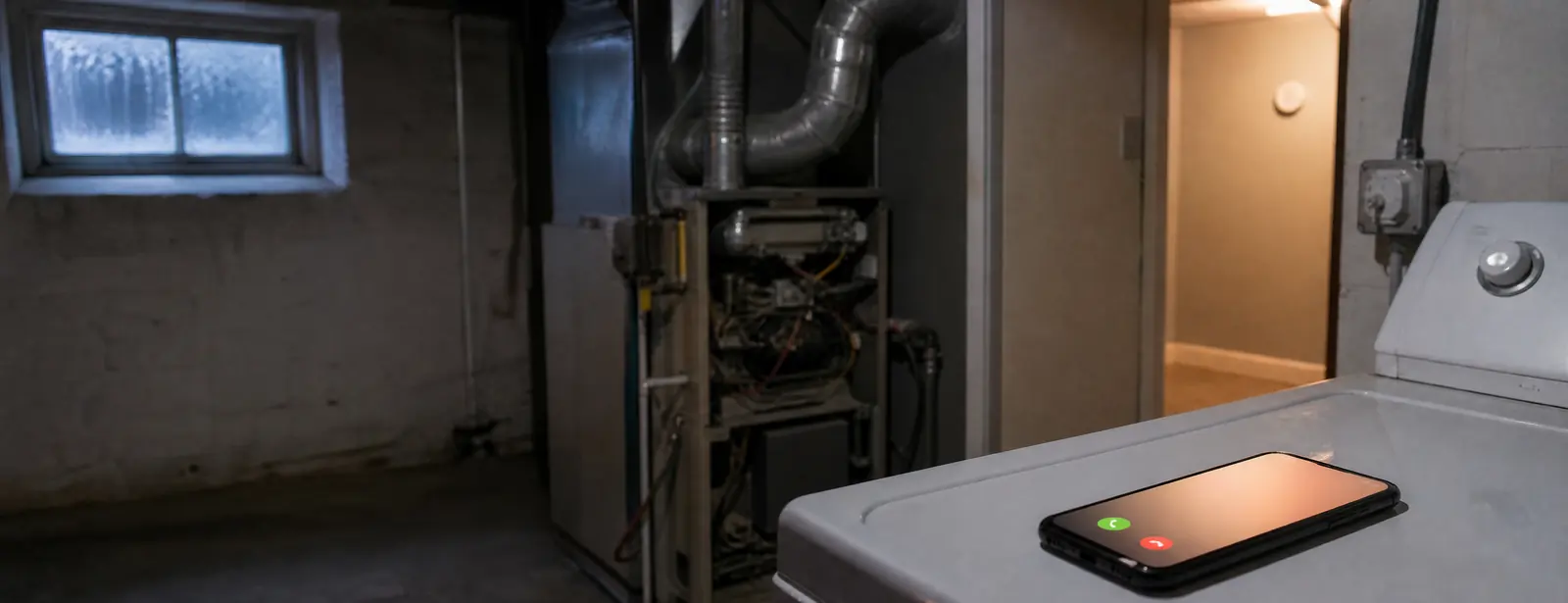
When HVAC calls come at the wrong time
It’s 6:40 on the first freezing morning of the season in Fargo. You’re in the shop loading vans, the office doesn’t open until eight, and the phones started ringing at five. Furnaces that limped through October quit overnight.
Some of those callers have an elderly parent in a cold house. One has a carbon monoxide alarm going off. Most have a furnace that won’t light. Two want a quote on a new system for spring. Right now the first truck goes to whoever kept redialing, not to whoever needs it most.
How the call goes
-
It answers for your company
The AI says: “Prairie Wind Heating & Cooling, this is AI Receptionist, the AI assistant. How can I help?”
-
It finds out what’s wrong, in plain words
The AI says: “Is the system completely off, or running but not keeping up?”
-
It checks for danger and for who’s at home
A carbon monoxide alarm, a gas smell or a burning smell stops the script: your safety line is read word for word and your on-call technician is alerted.
The AI says: “Any gas or burning smell, or a carbon monoxide alarm going off? And is anyone home elderly, very young or unwell?”
-
It asks whether they’re on a maintenance plan
If your plan promises priority service, members are offered your priority slots. Your office checks the account afterward.
The AI says: “Are you on one of our maintenance plans?”
-
It routes the call by your rules
Urgent calls go to your on-call technician, put straight through or emailed at once. The rest are booked and confirmed only once the booking is saved.
The AI says: “With no heat in freezing weather, this is urgent. Connecting you to our technician on call.”

Every question and hand-off of a no-heat or no-cooling call is laid out in our HVAC call script.
What counts as urgent
These are the defaults we start a heating and cooling company with. The temperatures, and every row, are yours to set.
| Situation | What happens |
|---|---|
| Carbon monoxide alarm, gas smell or burning smell | Your safety line first (leave the home, call from outside), then the on-call technician is alerted |
| No heat in freezing weather | Urgent: on-call technician now |
| No cooling in extreme heat, or the system down with someone vulnerable at home in any weather | Urgent: on-call technician now |
| Water dripping from the indoor unit through a ceiling | Urgent or first slot, by your rule |
| Plan member with the system down, nobody at risk | Your priority slot, if your plan promises one |
| System running but weak, or making a new noise | Next open slot |
| Tune-up, new system quote, duct cleaning | Booked, or passed to your comfort advisor |
What it never says on these calls
- A diagnosis, such as “sounds like the igniter” or “you’re probably low on refrigerant.”
- The price of a repair or a new system, or a financing offer you haven’t approved.
- What the warranty or the maintenance plan covers, beyond the lines you wrote.
- Steps to try at home, such as relighting a pilot or resetting a breaker.
- An arrival time you haven’t approved.
What you decide
- Your urgent list: the temperatures and situations that count as urgent where you work.
- Plan members: whether they get priority slots, and which ones.
- Who’s on call each night, and who’s the backup if they don’t answer.
- Your safety lines for carbon monoxide, gas and burning smells, in your words.
- Your service-call fee: quoted on the call or left for the technician.
- Sales calls: which requests go to your comfort advisor instead of a technician.
We set it up the way you want and you approve the final version.
Why this works for HVAC companies
Our call protocols come from nearly two decades of running phone reception for small businesses, and heating and cooling calls are a lesson in triage. It knows when to hand over: a no-heat call with a newborn at home goes to the technician on call, while a quote for a new heat pump goes to the person who sells them. It never promises what you don’t: “you’re in the priority slot” is fine because you set that slot; “the tech will be there by nine” is not, unless you approved it.
Both rules are explained on our method. Same method, different first question: our plumbing answering service starts with whether water is still running. All ten trades are on home services.
What it costs
HVAC calls come in waves: the first freeze, the first heat wave, then a quiet spring. Billing is per answered call, not per minute or per seat, so the quiet months cost little: Pay As You Go has no monthly fee and charges $0.99 per answered call. Once you know your season, the 50-Call Plan or the 100-Call Plan include calls for a fixed monthly fee. Compare them on pricing.
Free setup · No contract · Cancel anytime
Your month, by plan
Best fit: 50-Call Plan, $29.00
- Pay As You Go Best fit $29.70
- 50-Call Plan Best fit $29.00
- 100-Call Plan Best fit $49.00
What the month would cost on each plan: the monthly fee plus each call past the ones included.
Questions HVAC owners ask
Is it an HVAC after hours answering service, or does it answer all day?
Either. It works as a 24/7 HVAC answering service, as your line only when the office is closed, or as overflow when your dispatcher is already on a call. The rules can change by time of day: during office hours a no-heat call can go to your dispatcher, at night to your on-call tech. See after-hours answering.
What happens when everyone calls at once?
It takes several calls at the same time, so the first freezing morning doesn’t turn into a busy signal or a hold queue. The urgent calls are marked Urgent in your summaries, so your dispatcher starts the day knowing where the first trucks go.
How is an AI HVAC answering service different from a live one?
On a live service, the person on shift juggles your binder with calls for many other businesses. An HVAC AI receptionist, or HVAC virtual receptionist, has only your protocol: it asks about gas and who’s at home on every call, offers plan members the slots you set, and never puts a caller on hold while someone finds the binder. The questions don’t change at 3 a.m.
Will it sell or quote new systems?
No. A replacement quote depends on the home, the ductwork and the equipment, and that’s your comfort advisor’s job. The AI takes the address and the best time to visit, and books the in-home estimate or passes it on as a message. No ballpark figures.
Does this answering service for an HVAC company work with several technicians?
Yes. You tell us who’s on call and when, who covers which area and who gets which calls. As an HVAC call answering service it routes by those rules, and if a technician doesn’t answer, it tries the backup you named. Every call lands in one dashboard.
Be ready for the next cold snap
Press “Get started” with three things ready: your service area, your on-call rotation and how your maintenance plan works. We draft your HVAC protocol from it at no cost (how it works shows the three steps), and you sign off before the first call is forwarded.
Free setup · No contract · Cancel anytime