
Security and privacy
A secure answering service: what happens to every call we answer
Short answer
A secure answering service should tell you exactly who hears your calls, what gets kept and what never happens to it. AIReceptionistGo is a 100% AI receptionist: no operator listens in on your callers. Every caller hears that they’re talking to an AI and that the call may be recorded, the recording belongs to your business, and we never sell call data or use it for advertising. Here’s what happens to a call from the first ring to your inbox.
Free setup · No contract · Cancel anytime
What happens to a call, step by step
What happens to a call, step by step
-
The call rings on your number and forwards to us under the rules you chose: always, after hours, or when you’re busy.
-
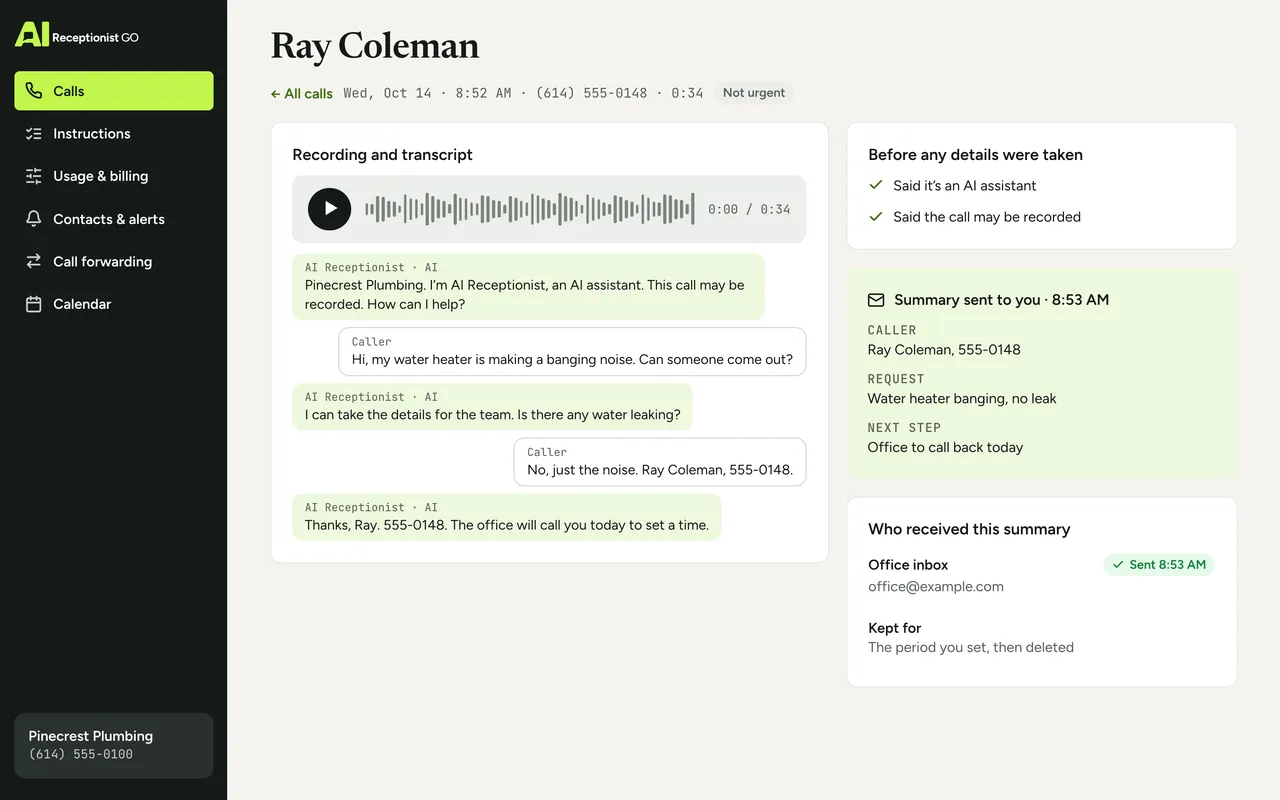
The AI receptionist answers. It gives your business name, says it’s an AI assistant and says the call may be recorded, before any details are taken.
-
It asks only what your protocol needs. Name, number, reason for calling, an address or a preferred time, depending on your industry. Nothing more.
-
The call is recorded and transcribed so you can check exactly what was said.
-
A summary goes to the people you chose. The recording and the transcript stay in your call dashboard. More on how that works on call recording and transcription.
-
Calls are kept for the period you set, then deleted. You can ask us to delete calls sooner.
No person listens in during the call. The people who can open your calls afterward are you, anyone on your team you choose to send the summaries to, and our staff when their work requires it, for example to set up or improve your protocol or to fix a problem you’ve reported.
What the AI receptionist never asks for
Your protocol decides what’s asked. Some things are off every protocol: the AI receptionist is instructed not to ask for payment card numbers, bank details, Social Security numbers or passwords, and to stop a caller who starts to give them. It doesn’t take payments over the phone.
That rule protects your callers, and it protects you: the less sensitive information there is in a call, the less there is to protect.
What we never do with your calls
-
We don’t sell call data
Not the recordings, not the transcripts, not your callers’ numbers.
-
We don’t use calls for advertising
Ours or anyone else’s.
-
We don’t share them for anyone’s marketing
The service providers that help run the service (telephony, voice and transcription technology, hosting, email delivery) may only use the information to provide that service, under written agreements.
-
We don’t pretend the AI is a person
If a caller asks, it says it’s an AI.
The full detail is in our privacy policy and our call recording and AI notice.
Who owns the recordings
Your business does. When we answer a call for you, we act as your service provider: we process the call on your instructions and for no other purpose. If one of your callers wants a copy of their call, a correction or deletion, they ask you, and we help you answer.
That’s also why you decide how long calls are kept, who receives each summary and which numbers get live transfers.
Call recording privacy and the law
Every call starts with a notice that it may be recorded, wherever the caller is. Some states require only one party’s consent to record a call; others require everyone’s. Telling every caller up front is how we handle that on every account. Our guide to call recording laws by state explains the difference. It’s general information, not legal advice: you remain responsible for the rules that apply to your business, especially in a regulated profession.
Security on our website
The same care applies before you’re a customer:
-
Our contact and signup forms ask only for what we need, usually four fields.
-
They’re protected against spam and abuse.
-
Newsletter signups are confirmed by email before anything else is sent, and every email has a one-click unsubscribe.
-
Form entries are kept only as long as we need them, then deleted.
-
Our analytics never receive your email address or phone number, and we respect the Global Privacy Control signal where the law requires it.
What we don’t claim
You won’t see security badges on this page. We’d rather tell you plainly what we do and don’t do than show you a badge. Some businesses need more detail before they forward a line: where recordings are stored, for how long, how they’re protected, or a written data processing agreement. Ask us before you sign up, through the contact page, and we’ll answer in writing. If we can’t meet a requirement, we’ll say so.
One specific case: AIReceptionistGo isn’t currently offered under a Business Associate Agreement. Healthcare practices shouldn’t use it to collect protected health information until one is signed with them.
How this compares
| Question | Voicemail on a shared phone | Live answering service | AIReceptionistGo |
|---|---|---|---|
| Who hears the call | Anyone with the phone or the PIN | An operator at the service | No person; an AI that says it’s an AI |
| Is it recorded and written down | Recorded; transcription depends on your phone service | Depends on the service; often notes typed by the operator | Recorded, transcribed and summarized on every call |
| What gets asked | Whatever the caller leaves | The operator’s script | Only what your protocol asks; never card numbers or passwords |
| Who decides how long calls are kept | Until someone deletes them | Depends on the service’s terms | You |
Price
Recording, transcripts, summaries and every protection on this page come with every plan. On Pay As You Go there’s no monthly fee: you pay $0.99 per answered call. Larger plans are on the pricing page.
Questions
Does a person listen to my calls?
While a call is live, only the AI receptionist is on it; no operator listens in. Afterward, the recording and transcript sit in your dashboard for you and the people you send summaries to. Our staff opens a call only when the work needs it, such as improving your protocol or fixing a problem you’ve reported. Nothing is sold or used for advertising.
Are my callers told the call is recorded?
Yes. At the start of every call, the AI receptionist says it’s an AI assistant and that the call may be recorded, before it takes any details. Callers who’d rather not be recorded can end the call and contact you another way. See our call recording and AI notice.
How long are recordings kept?
For the period you set for your account. After that they’re deleted, and you can ask us to delete calls sooner. If your business has its own retention rules, tell us before you sign up and we’ll tell you in writing whether we can match them.
Can the AI receptionist take credit card payments?
No. It doesn’t take payments, and it’s instructed not to ask for card numbers, bank details, Social Security numbers or passwords. If a caller starts to read out a card number, it stops them. Payments stay with you, through the channels you already use.
Is it safe for medical practices?
AIReceptionistGo isn’t currently offered under a Business Associate Agreement. Healthcare practices shouldn’t use it to collect protected health information until one is signed with them. If you run a practice, tell us what you need through the contact page and we’ll tell you honestly where things stand. It never gives medical advice.
Who owns the call data?
Your business. We process your calls on your instructions as your service provider. If a caller asks for a copy or deletion of their call, they ask you and we help you answer. We don’t sell call data, and our service providers can only use it to run the service.
Ask before you forward
Answering service privacy shouldn’t be a leap of faith. If anything on this page matters to how you work, ask us first and we’ll answer in writing. Our call protocols come from nearly two decades of running phone reception for small businesses, and keeping callers’ details to what the call needs is part of that job. Setup is free, there’s no contract and you can cancel anytime. Get started, or see how it works and our method.