
Industries
Funeral home answering service, every hour of the night
Short answer
A funeral home answering service takes your calls, day and night, when your director is on a removal, leading a service or finally asleep. Ours is a 100% AI receptionist that says gently that it’s an AI assistant, speaks calmly and briefly, and puts every first call through to your on-call director. It answers questions about service times and directions, reads your price list if you choose, takes messages for the family’s director, and sends you a summary of every call.
Free setup · No contract · Cancel anytime
Example call: a hospice nurse at 3 a.m.
A hospice nurse at 3 a.m.
- AI
- Ashgrove Family Funeral Home. This is the AI assistant. How may I help you?
- Caller
- This is Colleen Marchbanks, a nurse with Lakeview Hospice. We have a death to report.
- AI
- Thank you, Colleen. The name of the patient, and where they are?
- Caller
- Walter Ferris, at his home on Elm Avenue. The family chose Ashgrove.
- AI
- And a number to reach you?
- Caller
- 555-0198.
- AI
- Thank you. I’m connecting you with our director now.
Summary sent to you
- First call
- Walter Ferris, died at home, under hospice. Family chose Ashgrove.
- Caller
- Colleen Marchbanks, nurse, Lakeview Hospice, 555-0198.
- Done
- transferred to the on-call director. No arrival time given.
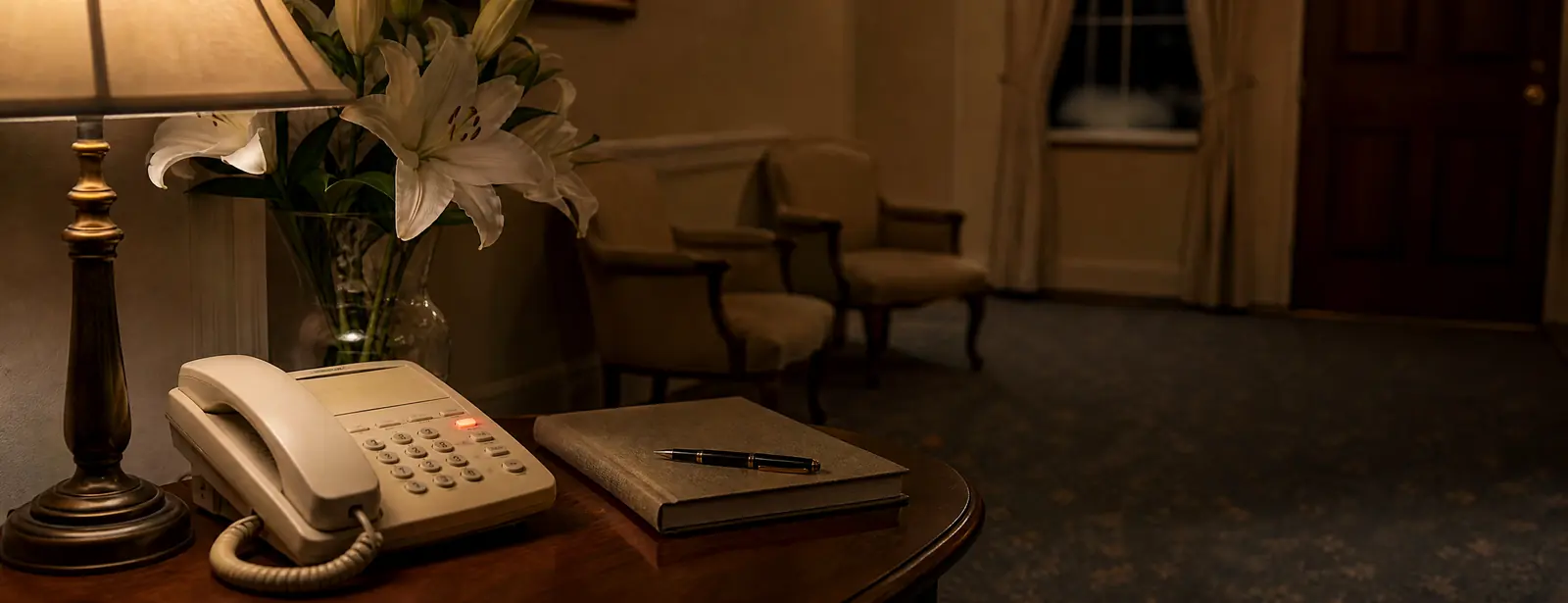
When funeral home calls come at the wrong time
It’s a Saturday in Duluth. Your director is at the graveside with a family, and the phone in his pocket is on silent, as it should be. In the next forty minutes, a hospice calls about a death, a florist asks where to deliver for tomorrow’s visitation, a son asks what time his mother’s service begins, and a woman wants to know what a cremation costs. At 3 a.m. the phone rings again. Each of those calls deserves a calm voice and a clear next step, not a full mailbox.
How the call goes
-
Answer quietly
The name of your funeral home, that this is an AI assistant, and an open question. No menu, no hurry.
The AI says: “Ashgrove Family Funeral Home. This is the AI assistant. How may I help you?”
-
Who is calling, and about whom
A family, a hospice or hospital, a family whose service is planned, or a general question. The answer decides what follows.
The AI says: “Could I have your name, and the name of the person you’re calling about?”
-
A death: straight to the director
For a first call, it asks only what the director needs to begin (the name, where the person is, whether a hospice nurse or doctor is present) and puts the call through. The full script, including the line for an unexpected death at home, is in our funeral home first call protocol.
The AI says: “Thank you. I’m connecting you with our director now.”
-
Everything else, from your protocol
Service times, directions and where to send flowers are answered from what you’ve given it. A family with arrangements underway gets a message to their director, or a transfer.
The AI says: “The visitation for Margaret Sorensen is Tuesday from 4 to 7 p.m. Would you like the address?”
-
Name and number, gently
If the director can’t answer, it takes a name, relationship and number, repeats the number back and says the director is being alerted now.
The AI says: “May I have the best number for our director? I’m letting them know right now.”

What counts as urgent
Here is the urgent list we start from for a funeral home. Yours replaces it.
| Situation | What happens |
|---|---|
| A death, reported by family, at any hour | Straight to your on-call director; the full first-call script is in the protocol |
| A death, reported by a hospice, hospital, care facility or medical examiner | Straight through; facility, name and callback number taken if nobody answers |
| A cemetery, church or vendor with a problem on the day of a service | Priority alert to the director leading that service |
| A family whose arrangements are underway | Message for their director, or put through, as you choose |
| Prices | Handled the way you set up: your list read as written, or a director calls back |
| Planning ahead for themselves or a parent | Message for whoever handles pre-planning, with no sales talk |
| Service times, directions, obituaries, flowers | Answered from your protocol |
What it never says on these calls
- Anything about the cause or circumstances of a death.
- Package names, upgrades or anything that sounds like selling.
- A time a director will arrive, or a date for a service the family hasn’t confirmed.
- A request for a name or number as a condition for giving a price.
- The words your staff use among themselves. Families hear plain, kind language.
What you decide
- Every word families hear: the greeting, the condolence line, how your director is introduced.
- Who is on call each night and weekend, and who answers if they can’t.
- Price calls: whether it reads your price list, or a director calls back.
- Service information: visitation times, directions and flowers.
- Pre-planning: who gets those calls.
- Spanish: families can speak Spanish with the AI on the same line, as in our Spanish-speaking caller protocol.
We set it up the way you want and you approve the final version.
Why this works for funeral homes
Our call protocols come from nearly two decades of running phone reception for small businesses, and a funeral call answering service is judged on how something is said as much as on what. It knows when to hand over: a family or a hospice reaches your director, not a form. It never promises what you don’t: no arrival times, no prices beyond your list, no talk of packages, because a family in grief should only hear what your home has chosen to say. More on our method, and on how a call is introduced before it connects on call transfer.
What it costs
A funeral home gets few calls, and every one matters, so paying $0.99 per answered call with no monthly fee on Pay As You Go usually fits. If your volume is higher, the 50-Call Plan includes 50 calls for $29 a month. Funeral home call answering costs the same at 3 a.m. as at noon. Plans are on pricing.
Free setup · No contract · Cancel anytime
Your month, by plan
Best fit: 50-Call Plan, $29.00
- Pay As You Go Best fit $29.70
- 50-Call Plan Best fit $29.00
- 100-Call Plan Best fit $49.00
What the month would cost on each plan: the monthly fee plus each call past the ones included.
Questions funeral home owners ask
Is an AI right for calls this personal?
You’ll judge that by listening. As your funeral home answering service, the AI says it’s an assistant, uses few words and gets families to your director quickly. Every call is recorded, so you can hear the tone yourself and change any line.
Can it be our funeral director answering service for nights and weekends only?
Yes. Your staff answer during the day and the line forwards to the AI after hours, at weekends or while everyone is at a service, with the same protocol and on-call schedule, so families hear the same calm voice at any hour. See the after hours answering service.
How does it handle price calls under the Funeral Rule?
Under the FTC’s Funeral Rule, a funeral home must give accurate prices from its price lists by phone, without asking for a name or number first. As you choose, the AI reads your list as written or a director calls back, and it never makes a name or number a condition for prices. If you choose callbacks, we settle during setup what a caller who won’t leave a number hears.
What if our director doesn’t pick up?
It tries the backup you named. If nobody answers, it takes the caller’s name, relationship and number, repeats it back and alerts your director at once. It doesn’t guess when someone will call back, and it doesn’t tell the family what happens next; that’s for your director.
Can it take calls about planning ahead?
It takes the caller’s name, number and what they’d like to discuss for whoever handles pre-planning. It doesn’t describe packages, and it never presses anyone to decide. Churches that host services have their own page, the answering service for nonprofits and churches; others are on industries.
When the next call comes, it’s answered
When you press “Get started”, we ask how your home handles each kind of call, who is on call and the words you want families to hear. We write the protocol with you, without charge for the setup, and your line is forwarded only after you’ve approved every word (how it works).
Free setup · No contract · Cancel anytime