
Feature
Overflow phone answering service: AI that takes the calls your front desk can’t
Your team still answers first. Line busy, or no one free to answer? A 100% AI receptionist picks up, and you get a summary. Busy line, or no one free to answer? A 100% AI receptionist picks up the call.
Free setup · No contract · Cancel anytime
Short answer
An overflow phone answering service catches the calls your receptionist can’t get to: when the line is busy, during lunch, or when three people call at once. With AIReceptionistGo, those extra calls are answered by a 100% AI receptionist that says it’s an AI, follows your protocol and sends you a summary. Your front desk keeps answering first. Nobody hears a busy signal or ends up in voicemail.
When the front desk is already on the phone
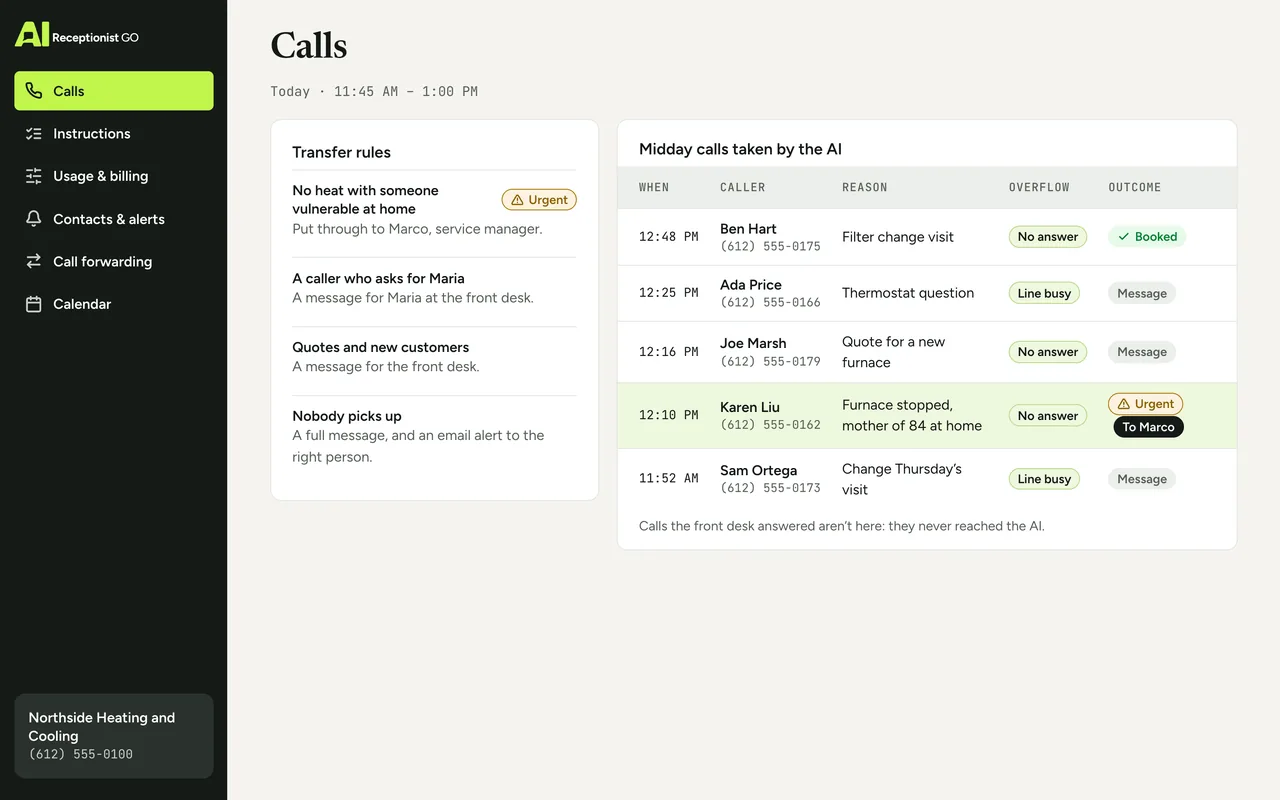
It’s 12:10 at a heating and cooling company. Maria, the receptionist, has just gone to lunch, and the office manager is on the line with a supplier. In the next fifteen minutes, two calls ring out at an empty desk: a homeowner whose furnace quit, and someone who wants a quote. Both get voicemail. The quote request may try again tomorrow. The homeowner with no heat won’t wait that long.
That is call overflow: not too many calls in a day, but more calls than free hands at one moment. Lunch, a busy line, a Monday rush. An overflow call handling service is there for those moments.
Tuesday · 12:00 to 12:30
Heating and cooling company
With an AI receptionist on the line
-
12:14
Homeowner: the furnace quit
Answered, marked urgent and passed to your on-call technician. -
12:21
New customer: wants a quote
Answered, address and details taken, summary sent to you.
What overflow call answering does
Your AI receptionist only steps in when your team can’t. When it does, it:
-
Answers right away with your business name. Several calls at the same time are fine; no caller waits behind another.
-
Asks your questions for that kind of call, in English or Spanish.
-
Transfers, books or takes a message, under your rules: live to the right person, into your calendar, or as a complete message.
-
Flags what can’t wait, and alerts the person you choose by email or by passing them the call.
-
Writes it all up, so your receptionist sees what happened without having to call anyone back.
How overflow call handling works
-
Your team answers first
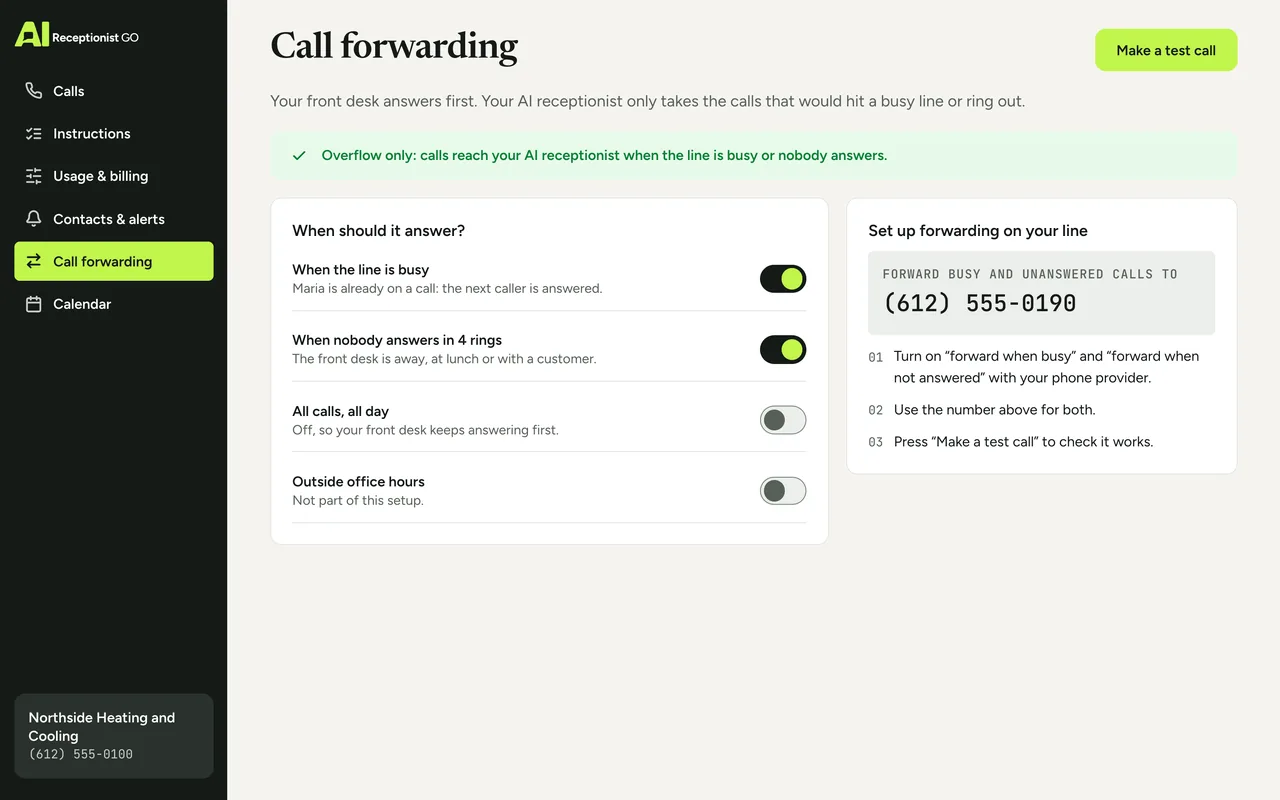
You forward your line on busy, on no answer, or both. Your phone rings at the front desk as usual. If it’s busy, or it rings out with no one free to answer, the call moves to your AI receptionist. How to set that up is on the call forwarding page.
-
The AI uses the same protocol your receptionist would
The questions follow a protocol made for your industry and adjusted to how your office works. A caller gets the same questions whether Maria answers or the AI does.
-
Calls that need a person reach a person
Some calls shouldn’t stay with the AI. A long-standing client, a job-site emergency, a caller who asks for someone by name: you decide which ones get transferred and to whom. If nobody answers, the AI takes the full message and alerts the right person.
-
Your receptionist picks up where the AI left off
Every overflow call is recorded, transcribed and summarized. Your front desk reads the summary and calls back the people who need it, already knowing what they want.
Example call: a no-heat call at lunchtime
Northside Heating and Cooling
12:10
Urgent
- AI
- Northside Heating and Cooling, this is AI Receptionist. I’m an AI assistant; our receptionist is away from the desk. How can I help?
- Caller
- My furnace stopped and the house is getting cold.
- AI
- I’m sorry. Is anyone home who can’t take the cold, like a baby or an older person?
- Caller
- My mother, she’s 84.
- AI
- Thank you. Your name and number?
- Caller
- Karen Liu, 555-0162.
- AI
- Thanks, Karen. I’m transferring you to Marco, our service manager, now.
Summary sent to you
- Urgent
- furnace stopped; an 84-year-old at home.
- Caller
- Karen Liu, 555-0162.
- When
- 12:10, front desk on lunch break.
- Done
- transferred live to Marco, service manager, under your no-heat rule.
Busy desk? The call still gets answered
Stop losing the calls that ring while your desk is busy or empty. Get started. Want to hear another trade first? Try the AI receptionist demo.
What you control when calls overflow
You decide; we build it that way.
-
When the AI takes over. Line busy, no answer, or both.
-
Who gets transferred live. Which calls go to your service manager, your receptionist or you, and which become a message.
-
What counts as urgent in your business, in your words.
-
What it can answer on its own. Hours, address, service area, what you do and don’t handle.
-
What it never says. No quotes, no arrival windows, nothing you haven’t signed off on.
The method behind each overflow call
Our call protocols come from nearly two decades of running phone reception for small businesses. Overflow is where that shows: the AI answers in the middle of your working day, next to a real front desk, so it has to work the way your office works: same questions, same rules, same people on the other end of a transfer. Three rules carry the load:
-
It asks what matters. The urgent question first, then name and number.
-
It knows when to hand over. Your transfer rules decide which calls go back to your team at once.
-
You see every call. Your receptionist reads each overflow call before picking up the thread.
The full approach is on our method.
Your protocol · Heating & Cooling
ApprovedOn the call above · Northside Heating and Cooling (example)
-
It asks what matters
On this call: Asked first: anyone home who can’t take the cold?
-
It knows when to hand over
On this call: Your no-heat rule → transferred to Marco
-
It never promises what you don’t
-
It escalates real emergencies
-
You see every call
On this call: Front desk reads it after lunch
Overflow answering service options compared
When your line is busy, a caller usually gets one of three things. Here’s how they compare.
-
What the caller gets
Hold queue: Music and a wait
Voicemail when busy: A beep and a recordingAIReceptionistGo
An answer with your business name
-
Calls at the same time
Hold queue: One at a time, the rest wait
Voicemail when busy: One message after anotherAIReceptionistGo
Several at once, nobody waits
-
Urgent calls
Hold queue: Wait in line like the rest
Voicemail when busy: Found when you listen to messagesAIReceptionistGo
Flagged and transferred under your rules
| Hold queue | Voicemail when busy | AIReceptionistGo | |
|---|---|---|---|
| What the caller gets | Music and a wait | A beep and a recording | An answer with your business name |
| Calls at the same time | One at a time, the rest wait | One message after another | Several at once, nobody waits |
| Urgent calls | Wait in line like the rest | Found when you listen to messages | Flagged and transferred under your rules |
| What your team gets | The call, once someone is free | Audio messages to play back | Summary, recording and transcript |
If you’re coming from a call center, most call center overflow solutions work the same way: the AI covers the spikes, and your people keep the calls that need them.
What an overflow call answering service costs
Only the calls the AI picks up count toward your plan; the ones your team answers never do. When just a few calls spill over, Pay As You Go fits: no monthly fee, $0.99 for each call the AI takes. If your busy hours send more, a plan with calls built in may suit you better: the 50-Call Plan includes 50 calls for $29 a month; the 100-Call Plan raises that to 100 for $49. Count last month’s missed calls and compare them on pricing.
Free setup · No contract · Cancel anytime
Your month, by plan
Best fit: Pay As You Go, $11.88
- Pay As You Go Best fit $11.88
- 50-Call Plan Best fit $29.00
- 100-Call Plan Best fit $49.00
What the month would cost on each plan: the monthly fee plus each call past the ones included.
Questions about overflow call answering
What is an overflow answering service?
An overflow answering service answers the calls your own team can’t take at that moment, usually because the line is busy or nobody picks up in time. It works alongside your receptionist, not instead of them. With AIReceptionistGo, an AI receptionist takes those calls, follows your industry’s protocol and sends your team a summary of each one.
Will my receptionist feel replaced?
The setup is built around your receptionist. They still answer first, and the AI only takes the calls they can’t reach. Most of what it does is hand calls back: live transfers, messages and summaries your receptionist reads before calling people back. In practice, it removes the queue and the pile of voicemails, not the person at the desk.
How many of my calls will the AI actually take?
Only the ones your line forwards: calls that hit a busy signal or ring out at an empty desk. For most offices that’s a handful a day, not the whole phone. Each summary marks the call as overflow, so after a month you know the real number and can pick the plan that fits it.
Can it answer at night as well as during busy hours?
Yes, with one more forwarding rule. Overflow covers your working day; you can add all calls outside your hours on top. Nights and weekends are explained on the after hours answering service page; answering every call around the clock is on the 24/7 answering service page.
Do the AI and my receptionist ever answer the same call?
No. A call reaches the AI only after your line has passed it on, so it’s either at the front desk or with the AI, never both. If the AI transfers it back to your team, the person who picks up gets it as a normal call, and the summary shows what was already asked.
Can it answer common questions so fewer calls need my team?
Yes, the ones you approve. Opening hours, your address, your service area, what you do and don’t handle: the AI answers them and closes the call. Questions about prices, dates or advice go to your team unless you’ve approved an answer. For more on answering routine questions, see customer service answering.
Keep your front desk, lose the queue
Two answers get you going: when your front desk can’t pick up, and which calls should come straight back to a person. We write the protocol so the AI asks what Maria would ask, you read it, and from then on the call that rings at an empty desk gets answered instead of a beep. Not sure yet? How it works shows every step.