
Legal
Answering service for solo practitioners: your front desk while you’re in court
Short answer
An answering service for solo practitioners is a lawyer’s front desk when there’s nobody else in the office: it answers while you’re in court, with a client or driving, and decides which calls can’t wait. Ours is 100% AI and tells callers so. It takes intake details from new clients, takes exact messages from court clerks and opposing counsel, and only interrupts you for the calls on your list. Everything else is in your inbox and your dashboard when you walk out of the courtroom, each call with its summary and the urgent ones marked.
Free setup · No contract · Cancel anytime
Example call: opposing counsel wants to move a hearing
Law Office of Renee Calloway · Opposing counsel wants to move a hearing
- AI
- Law Office of Renee Calloway, this is AI Receptionist, the firm’s AI assistant. How can I help?
- Caller
- Martin Pryce, opposing counsel on the Delmar matter. I need to move Friday’s hearing.
- AI
- I can’t agree to any change, but I’ll pass it on. What date are you proposing?
- Caller
- Next Tuesday or Wednesday.
- AI
- And a number to reach you?
- Caller
- 555-0104.
- AI
- Thank you, Mr. Pryce. I’ve marked this urgent for Ms. Calloway.
Summary sent to you
- Urgent, opposing counsel
- Martin Pryce, Delmar matter. Asks to move Friday’s hearing to next Tuesday or Wednesday.
- Callback
- 555-0104.
- Done
- message only. Nothing agreed; no case details discussed.
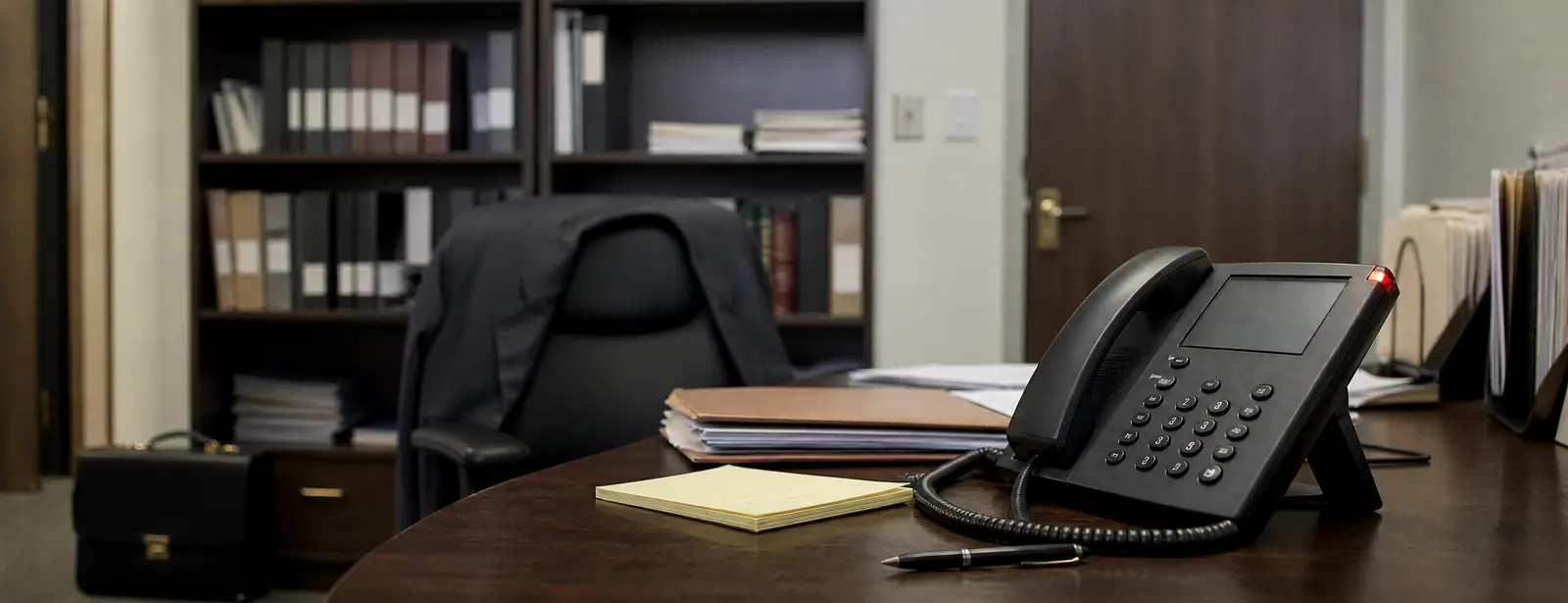
When solo attorney calls come at the wrong time
It’s 9:40 on a Tuesday morning. You’re third on the docket in courtroom 4B, your phone is off, and your office down the street is locked. There’s nobody to answer it, because the office is you.
When you’re out, at 11:15, the voicemail has a prospective client who left no number, a current client asking whether Friday is still on, a directory selling ads and opposing counsel who wants to move a hearing. You listen in the car, between bites of lunch, in the order they arrived.
How the call goes
-
Your office, and your line about availability
Your office’s name, that it’s an AI assistant, and your approved line about availability, which never says where you are.
The AI says: “Law Office of Renee Calloway, this is AI Receptionist, the firm’s AI assistant. Ms. Calloway is unavailable right now. How can I help?”
-
Who’s calling?
A new client, a current client, a clerk, opposing counsel, a process server or a vendor: each takes a different path, and it asks if it can’t tell.
The AI says: “Are you calling about a new matter, about a case the office already has, or from the court?”
-
New clients: a short intake
What the matter is, who’s on the other side, any date coming up and a callback number. If you allow it, it books a free slot in your calendar.
The AI says: “I can’t give legal advice, but I’ll note who’s on the other side so Ms. Calloway can check for conflicts. Booking a time doesn’t mean the firm has taken your case.”
-
Everyone else: the exact message
Clerks, opposing counsel and current clients get their message taken word for word: who, which matter, what they want and by when. Nothing is agreed on your behalf.
The AI says: “I can’t agree to any change, but I’ll pass it on. What date are you proposing?”
-
Interrupt, or wait for the list
On your interrupt list: a call to your cell or an urgent email. If not, its summary waits with the others. For a new client, the full question order is in our intake script for attorneys.
The AI says: “I’ve marked this urgent for Ms. Calloway.”

What counts as urgent
For a one-attorney office, these are the rules we start from. Your rules replace them.
| Situation | What happens |
|---|---|
| The court clerk or a judge’s chambers | Put through to your cell, or an urgent email, by your rule |
| Opposing counsel about a hearing this week | Urgent message with the request and their number; nothing agreed |
| A current client with a hearing inside your urgent window | Rung through to you or emailed right away, by your rule |
| A new matter with a court date or deadline inside your window | Urgent email with the date; consultation offered by your rules |
| Someone trying to deliver papers | Message with how to reach your office; it can’t accept anything |
| Legal directories, marketing calls, robocalls | Screened out; listed in your summary, never put through |
| A new matter with no date | Consultation booked or requested for when you’re free |
What it never says on these calls
- That you’ll agree to a continuance, a new date or an offer.
- Where you are, or when you’ll be back, beyond the line you approved.
- Any legal advice, or any detail about a case, to anyone who calls.
- That it can accept papers or anything else on your behalf.
- What a consultation costs, or whether the first one is free, unless you’ve approved the words.
What you decide
- Your interrupt list: who can reach you in court, and how, by a call to your cell or an urgent email.
- Quiet hours: court mornings, client meetings, evenings, when only the list gets through.
- What callers hear about your availability, in your words.
- Consultations: which slots it can book, and which matters you want to screen first.
- Current clients: put through, a message, or a set time to call back.
We set it up the way you want and you approve the final version.
Why this works for solo attorneys
Our call protocols come from nearly two decades of running phone reception for small businesses, and plenty of them had one person doing everything. An answering service for solo attorneys has to replace the judgment a good assistant would use about who’s worth an interruption. It knows when to hand over: the court clerk reaches you, the ad salesman doesn’t. You see every call: recording, transcript and a summary of each, with the urgent ones marked, so you read the clerk’s message before the directory’s pitch. The rules are on our method and the setup on how it works; keeping the ad salesman out is call screening.
What it costs
A solo office often has a few calls a day, which is what Pay As You Go is for: no monthly fee and $0.99 per answered call. If the phone gets busier, the 50-Call Plan covers a month of calls for one price. How the per-call plan works is on pay-per-call answering service, and every plan on pricing.
Free setup · No contract · Cancel anytime
Your month, by plan
Best fit: 50-Call Plan, $29.00
- Pay As You Go Best fit $29.70
- 50-Call Plan Best fit $29.00
- 100-Call Plan Best fit $49.00
What the month would cost on each plan: the monthly fee plus each call past the ones included.
Questions solo practitioners ask
What does an answering service for solo practitioners do?
It sorts calls by who’s calling, which matters when you’re the whole office: a new client gets a short intake, a clerk or opposing counsel an exact message, a directory nothing. If a caller won’t say who they are, it takes the message and marks it.
Can it reach me in court without my phone going off?
Your rules decide. Most calls wait for your summary. For the few that can’t, it puts the call through to your cell or sends an urgent email, so you choose whether your phone is on vibrate or off. A clerk’s call can ring through while a new client’s waits.
Is there a Spanish answering service for solo attorney offices?
Yes, on the same number. A caller who speaks Spanish gets your protocol in Spanish, interrupt list and all, without pressing a key. You don’t need to speak Spanish to approve it: you get the English version line by line. See bilingual AI receptionist.
What do my current clients hear?
The same greeting, then a choice you make: a message taken word for word, a call put through if they’re on your interrupt list, or a callback time you’ve set. It never tells them anything about their case, even when they ask whether a hearing is still on.
Is it cheaper than a part-time assistant?
They’re paid differently: an assistant for hours, including the quiet ones; this per answered call, with no monthly fee on Pay As You Go, nights included. An assistant can also do your filing and billing; this only answers the phone. More on AI receptionist for small business.
Your front desk, while you’re in court
Press Get started with three things in hand: your practice, your interrupt list and what callers hear about your availability. You approve the draft line by line between hearings, and only then forward your office number. If you take family cases, see family law; every practice area is on the attorney answering service page.
Free setup · No contract · Cancel anytime