
Industries · Waitlist open
Call center for healthcare practices, answered 100% by AI
Short answer
A call center for healthcare practices answers your patients’ calls on the first ring: it gives the 911 line, books and moves visits, takes messages and reaches your on-call staff by your rules. Ours is 100% AI, tells every caller so in its first sentence and never gives medical advice. It’s built for small practices and agencies, from a family doctor to a home health team, and every call reaches you as a written summary.
This is a phone-answering service for medical offices. It doesn’t give medical advice, and callers with an emergency are told to hang up and call 911.
No payment needed to join the waitlist.
Example call: moving a home health visit
Ridgewater Home Health · Moving a home health visit
- AI
- Ridgewater Home Health, this is AI Receptionist, the agency’s AI assistant. If this is a medical emergency, please hang up and call 911.
- Caller
- It’s about my mother’s nurse visit Thursday morning.
- AI
- Your name, and your mother’s name?
- Caller
- Leah Pettersen. My mother is Ruth.
- AI
- What would you like to change?
- Caller
- Afternoon instead. I can’t be there before noon.
- AI
- I’ll pass it to the scheduler. Best number?
- Caller
- 555-0103.
- AI
- Thanks, Leah. The scheduler will call to confirm.
Summary sent to you
- Family member
- Leah Pettersen, 555-0103, daughter of Ruth Pettersen.
- Request
- move Thursday’s nurse visit from morning to afternoon.
- Pending
- scheduler to confirm the new time with Leah.
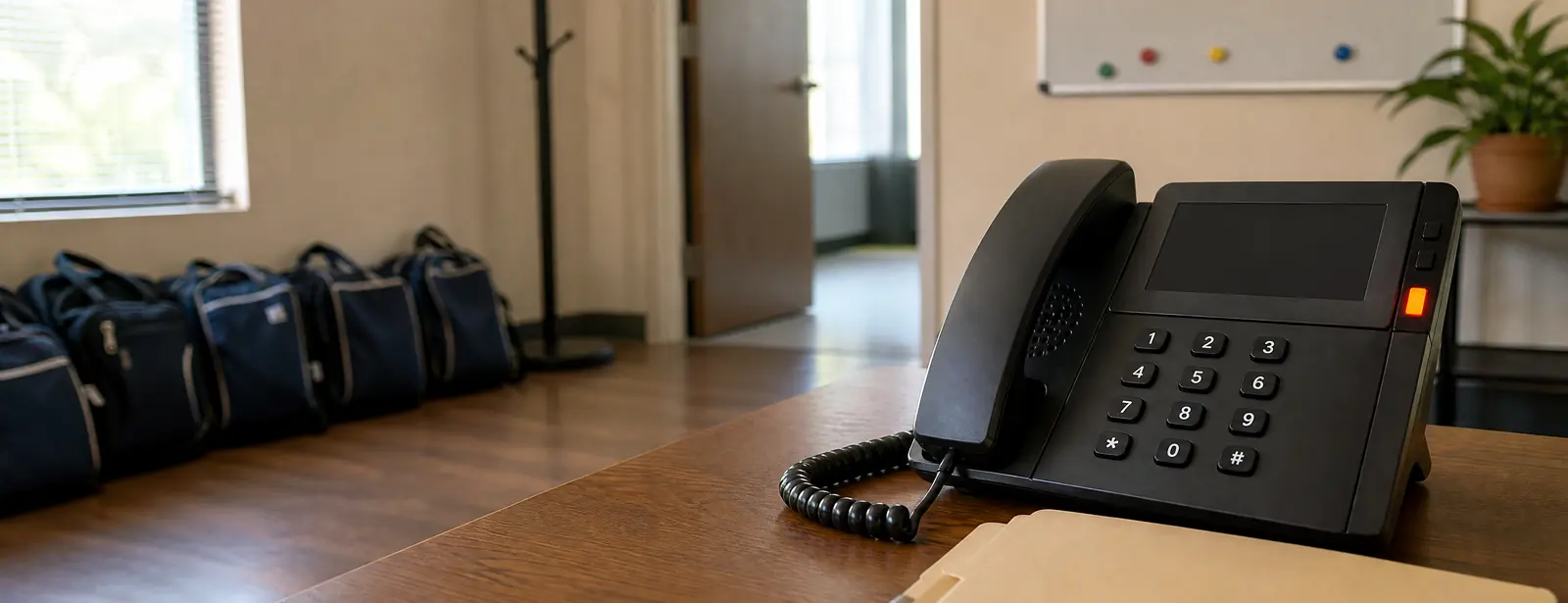
When healthcare calls come at the wrong time
At 8 a.m. in Cedar Rapids, a clinic’s front desk is checking in a full waiting room. Across town, the scheduler at a home health agency is driving between visits when her phone rings: a daughter wants to move her mother’s nurse visit. At 11 p.m., a hospice family calls the after-hours number. One call needs a booking, one a message, one a nurse woken up right away. None of them should end in voicemail.
How the call goes
-
Answer as your practice, with your emergency line
The caller hears your name, that they’re speaking with an AI assistant, and your emergency line before any question: 911 for most practices, your on-call nurse for a hospice’s families.
The AI says: “Ridgewater Home Health, this is AI Receptionist, the agency’s AI assistant. If this is a medical emergency, please hang up and call 911.”
-
Who is calling
A patient, a family member or caregiver, a hospital, a pharmacy or another provider. In healthcare, who’s calling decides almost everything that follows.
The AI says: “Are you calling for yourself, for a family member, or from another office?”
-
Do what you’ve allowed
Visits booked, moved or canceled in your calendar; or, if your schedule is set by a coordinator, the request taken and left pending for them to confirm. Messages for billing, records and forms are written down with a callback number.
The AI says: “I’ll send this to the scheduler, and they’ll confirm the new time with you.”
-
Reach the person on call, by your rules
Hospitals, other providers and callers who ask for the on-call doctor or nurse are put through, or the person on call is alerted, following your schedule. The AI never decides from symptoms whether someone needs them.
The AI says: “I’ll reach the on-call nurse now and give her your number. Please stay by the phone.”
-
Send you the summary
Every call ends with a summary in your inbox, and the recording and transcript in your dashboard. Night calls follow our after-hours triage protocol.

What counts as urgent
In healthcare, the AI doesn’t judge symptoms. Urgency comes from what the caller asks for and from your rules.
| Situation | What happens |
|---|---|
| Family of a hospice patient calls at night | Your on-call nurse reached right away; no 911 line read unless you want it |
| Caregiver says the nurse hasn’t arrived for today’s visit | On-call coordinator reached right away |
| Caller says it’s an emergency | Your emergency line, in your words: 911 for most practices, your on-call nurse for hospice families |
| Family asks when the nurse is coming today | Visit window read from your schedule, or the scheduler reached; no arrival time promised |
| Pharmacy or medical supply company calling about a delivery | Message for your scheduler, with the patient’s name and the callback number |
| Request to move a visit | Done in your calendar, or left pending for your scheduler |
Specialties
Each specialty gets its own protocol. Start with yours.
-
Medical practices
“Are you a patient here, or calling from a pharmacy or another office?”
New patients, pharmacies and hospital calls during a busy day, with the on-call doctor reached by your rules
-
After-hours medical calls
The 911 line first at night, your on-call rotation and tomorrow’s visits moved overnight
-
Dental offices
“Have you been to our office before, or would this be your first visit?”
New patients and cleanings, same-day slots, orthodontic visits; insurance noted, never promised
-
Chiropractic clinics
“Have you been to the clinic before, or is this your first visit?”
New patient exams and adjustments, with accident and work-injury details noted for your team
-
Physical therapy clinics
“Are you a current patient, or would this be your first visit?”
Sessions moved within the week, so patients stay on their plan of care
-
Therapy and mental health practices
“Would you like to meet in person or by video?”
First appointments without questions about why, and 911 and 988 on any sign of crisis
-
Med spas and aesthetic clinics
“Which treatment are you interested in, or would you like a consultation first?”
Consultations booked and only your approved prices read; questions after a treatment go to your team
-
Veterinary clinics
“What’s your name, and your pet’s name?”
Pet emergencies sent to your 24-hour clinic, never assessed on the phone; available today
-
HIPAA and answering services
An honest guide: what a medical answering service must sign, and where we stand today
What it never says on these calls
- When the nurse will arrive, beyond the window you set.
- Anything about a patient’s condition, plan of care or medications.
- Whether insurance covers a visit or what it will cost, unless you’ve approved the exact words.
- That a nurse or doctor is on the way, or will call back within a set time.
What you decide
- Who answers for what: front desk, scheduler, billing, on-call nurse or doctor.
- Your on-call schedule, with a backup if the first person doesn’t pick up.
- What it can book directly and what goes to a coordinator as pending.
- Which callers reach a clinician: hospitals, other providers, families, patients who ask.
- Your emergency line: 911 for most practices; a hospice agency usually tells families to call its on-call nurse first, and that’s the line the AI reads.
- Your greeting, in English and Spanish.
We set it up the way you want and you approve the final version.
Why this works for healthcare
Our call protocols come from nearly two decades of running phone reception for small businesses. In healthcare, two rules come before everything else. It escalates real emergencies: the 911 line on every call, and the person on call reached the way you set it, without the AI judging symptoms. It never promises what you don’t: no advice, no results, no visit time that your scheduler hasn’t confirmed. The rest is on our method. If you’re comparing providers, our guide to the best medical answering services compares the three types.
What it costs
A family that needs five minutes to explain a visit change is still one answered call: we never bill by the minute, and there’s no contract. Rates for agencies and practices are agreed with you when we reach your specialty on the waitlist. Veterinary clinics aren’t on the waitlist: they can start today on the plans shown on pricing.
Questions healthcare owners ask
What does a call center for healthcare do?
It answers patients’ calls for a practice, a clinic group or a hospital: appointments, messages, calls from other providers and after-hours calls for the person on call. Large hospitals often run their own hospital contact center; ours is built for small practices and agencies, with an AI doing the same front-line work on every call.
Is a health care answering service the same as a health care call center?
Mostly, yes. “Answering service” usually means a smaller operation that takes calls and messages for a practice; “call center” suggests more volume and more types of calls. For a practice with one or a few locations, what matters is the same: answered on the first ring, the right questions asked, and nothing promised that the practice didn’t approve.
Do you answer for hospice and home health agencies?
Yes, for the administrative side. Families call to move visits, ask when the nurse is coming or reach the on-call nurse at night. The AI takes changes for your scheduler, reaches your on-call nurse by your rules and never comments on a patient’s condition. Families who say it’s an emergency hear the line you set, usually your on-call nurse for hospice patients.
Is a doctor call center different from a medical answering service?
Not really: both answer for the doctor when the office can’t. A doctor call center often means coverage for several physicians or sites. We set up one protocol per practice, route calls by provider and location, and every summary says who the call was for. Details are on medical answering service.
Is a healthcare answering service enough for a small practice, or do we need a call center?
For one or a few locations, a healthcare answering service usually covers it: visits, messages and the person on call. Many health care answering services run by people bill by the minute. Ours is an answering service for healthcare that answers several calls at once and bills by the answered call, so a busy Monday morning never means a busy signal.
Can it take calls from families who speak Spanish?
Yes. The AI answers in English or Spanish on the same line, without asking anyone to press a key, which matters when a caregiver or a grandchild calls about a visit. Your greeting and your emergency line are set in both languages. More on bilingual answering.
Join the healthcare waitlist
Healthcare practices and agencies join through a waitlist for now. Tell us your specialty, or your agency’s service area, in the waitlist form on this page; when your turn comes, we build the protocol with you and you approve every line before a family hears it. How setup works is on how it works, and every other industry we answer for is on industries.
Free to join · No commitment