
Healthcare · Waitlist open
Medical answering service for doctors’ offices, run 100% by AI
Short answer
A medical answering service picks up your office’s calls when the front desk can’t: it books and moves appointments, takes messages and reaches your on-call doctor by your rules. Ours is 100% AI, says so at the start of every call and never gives medical advice. You get a written summary of every call, so the day starts with a list instead of a voicemail box.
This is a phone-answering service for medical offices. It doesn’t give medical advice, and callers with an emergency are told to hang up and call 911.
No payment needed to join the waitlist.
Example call: a new patient asking for a first visit
Ahtanum Ridge Family Medicine · A new patient asking for a first visit
- AI
- Ahtanum Ridge Family Medicine, this is AI Receptionist, the practice’s AI assistant. If this is a medical emergency, please hang up and call 911.
- Caller
- Hi, I just moved here. Are you taking new patients?
- AI
- Yes. Your name and best number?
- Caller
- Darnell Hughes, 555-0119.
- AI
- Thanks, Darnell. The first opening is Thursday at 10:40, or Friday at 2:15.
- Caller
- Thursday.
- AI
- You’re booked for Thursday at 10:40. Registration is done at your first visit.
Summary sent to you
- New patient
- Darnell Hughes, 555-0119, new to the area.
- Booked
- new patient visit, Thursday at 10:40 a.m.
- Next step
- registration at the first visit; nothing to send before.
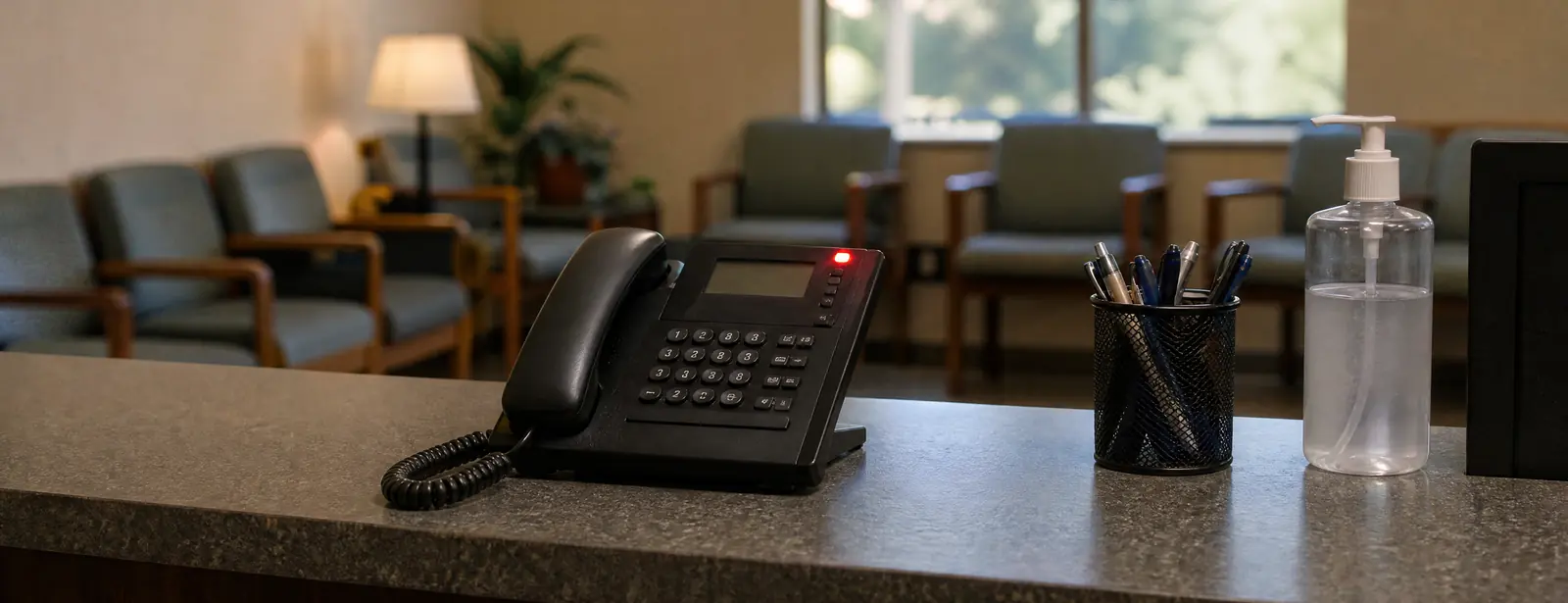
When medical office calls come at the wrong time
It’s 8:05 on a Monday at a family practice in Yakima. Two people are checking in at the window, the medical assistant is rooming the first patient, and three lines ring at once: a patient moving Thursday’s visit, a pharmacy with a question for the doctor, and someone new in town asking whether the practice takes new patients. The front desk can answer one. The other two hear a recording, again at lunch, at 4:55 p.m. and all weekend. None of these calls is hard. Each needs someone who answers on the first ring and knows what the office wants done with it.
How the call goes
-
Answer as your practice, with the 911 line first
Your practice name, that it’s an AI assistant, and the emergency line, before any question.
The AI says: “Ahtanum Ridge Family Medicine, this is AI Receptionist, the practice’s AI assistant. If this is a medical emergency, please hang up and call 911.”
-
Find out who is calling
A patient, a new patient, a pharmacy, a hospital or another office. Each one goes somewhere different.
The AI says: “Are you a patient here, or calling from a pharmacy or another office?”
-
Handle what you’ve allowed
Appointments are booked, moved or canceled in your calendar, for the visit types and providers you allow. A visit is confirmed only once it’s saved; if the calendar can’t take it, the request stays pending for your staff.
The AI says: “The first opening is Thursday at 10:40, or Friday at 2:15. Which works better?”
-
Pass on what it shouldn’t handle
Questions for a clinician, results, refills and forms become a message for your staff. A caller who asks for the on-call doctor is put through, or the doctor is alerted, following your schedule.
The AI says: “I can’t answer medical questions, but I’ll pass this to the care team. What’s the best number to reach you?”
-
Send you the summary
Every call reaches you as an email summary, with the recording and transcript in your dashboard. When the office is closed, the same call follows our after-hours triage protocol.

What counts as urgent
In a medical office, the AI doesn’t decide what’s urgent from symptoms. It goes by what the caller asks for and by your rules.
| Situation | What happens |
|---|---|
| Caller says it’s an emergency, or that someone is in danger | Told to hang up and call 911; your on-call contact gets the summary |
| Caller asks to speak with the on-call doctor | Put through, or the doctor is alerted, following your on-call schedule |
| A hospital or ER calling for one of your doctors | Routed to that doctor or to whoever is on call, per your list |
| A pharmacy with a question for the doctor | Message for the doctor, or put through if you allow it |
| Patient wants to book, move or cancel a visit | Done in your calendar, or left pending if it can’t confirm |
| Refills, results, forms or billing | Message for your staff, with a callback number |
What it never says on these calls
- Medical advice, or whether something sounds serious or can wait.
- Test results, diagnoses or anything from a patient’s chart.
- That a refill is approved or a prescription is ready.
- Whether insurance covers a visit or what it will cost, unless you’ve approved the exact words.
- A callback time you haven’t promised.
What you decide
- Your on-call schedule: who covers nights and weekends, and a backup if they don’t pick up.
- Who gets which calls: hospitals, pharmacies, labs and other offices, by name or by role.
- What it books: visit types, providers, whether you take new patients and how far ahead.
- Your greeting and your 911 line, in English and Spanish, and who on your staff gets each summary.
- What it says about insurance and fees: your approved words, or nothing at all.
We set it up the way you want and you approve the final version.
Why this works for medical offices
Our call protocols come from nearly two decades of running phone reception for small businesses. In a doctor’s office, two rules do most of the work. It escalates real emergencies: the 911 line comes before the first question, and a call for the on-call doctor reaches them the way you set. It never promises what you don’t: no advice, no results, no “the doctor will call you within the hour.” The rest is on our method, and how a call is passed to a person is on call transfer.
What it costs
A new patient who calls at 4:55 p.m. and books a visit is one answered call; a pharmacy that calls three times about the same refill is three. We never bill by the minute and there’s no contract. Your practice’s rate is agreed with you, before you commit to anything, when we reach your specialty on the waitlist; current plans for businesses outside healthcare are listed on pricing.
Questions medical office owners ask
What does a medical answering service do?
A medical office answering service answers your phone when your staff can’t: it books and moves appointments, takes messages for the care team, passes calls from hospitals and pharmacies to the right person and reaches your on-call doctor when a caller asks. Ours does it with AI, by your rules, and never gives medical advice.
Is an automated medical answering service just a phone menu?
No. A phone menu makes callers press keys and often ends in voicemail. An AI medical receptionist talks with the caller, asks who they are and what they need, and does the task: books the visit, takes the message or puts the call through. Nobody presses 1.
Can a medical virtual receptionist handle new patient calls?
Yes. It tells callers whether you’re accepting new patients, books the new patient visit types you allow and leaves registration to your staff. It writes the new patient’s name and number in the summary so the office can prepare the chart. If you’re full, it says so politely and, if you want, names a practice you recommend. Healthcare practices join through the waitlist for now, because a Business Associate Agreement (BAA) isn’t signed yet.
Does it work for physician groups and specialists?
Yes. A physician answering service for a group routes calls by provider and location, and a specialist’s office asks different questions, such as whether there’s a referral and which doctor sent the patient. Every summary says which provider or site the call was for. Healthcare practices join through the waitlist for now, because a Business Associate Agreement (BAA) isn’t signed yet.
How much does a medical answering service cost?
It depends on how the service bills. When a service charges by the minute, long calls cost more. We charge by the answered call, with no contract. The rate for a medical practice is agreed with you when your waitlist turn comes; our general plans are on pricing.
What happens when a patient needs the doctor at night?
The 911 line comes first. Then the call goes to your on-call doctor, or to a message for the morning, as your on-call rules say. How nights and weekends work is on after-hours medical answering, and the setup steps are on how it works.
Join the healthcare waitlist
Why a waitlist: a medical office needs a business associate agreement with any service that handles its calls, and ours isn’t signed yet. What that means, and what to ask any service, is in our guide to HIPAA and answering services. Add your practice, your providers and your busiest hours in the form on this page, and we’ll call when we can build your office’s protocol. Other specialties are on healthcare, including dental offices.
Free to join · No commitment