
Legal
Answering service for family law attorneys: safe, discreet first calls
Short answer
An answering service for family law attorneys has to get three things right on the first call: the caller’s safety, their privacy, and the name of the other spouse or parent, so your firm can check for a conflict. Ours is 100% AI. It says so, asks whether it’s a safe time to talk, notes the number it may call and whether a message can be left there, and sends you a summary. It never gives legal advice or takes sides.
Free setup · No contract · Cancel anytime
Example call: a discreet first call about divorce
Lindqvist Family Law · A discreet first call about divorce
- AI
- Lindqvist Family Law, this is AI Receptionist, the firm’s AI assistant. I can’t give legal advice. Is this a good time to talk?
- Caller
- Yes. I want to file for divorce.
- AI
- Your spouse’s full name?
- Caller
- Gregory Albright.
- AI
- Is it safe to leave you a message?
- Caller
- No. Call my cell after six. Monica Albright, 555-0168.
- AI
- Understood: no messages, calls after six. I’m sending this to an attorney; that doesn’t mean the firm has taken your case.
Summary sent to you
- Contact rule
- do not leave messages. Call 555-0168 (cell) after 6 p.m. only.
- New matter
- divorce, no court date. Spouse: Gregory Albright (for conflict check).
- Caller
- Monica Albright. **Done:** consultation request sent to the attorney. No advice given. Told this doesn’t mean the firm has taken the matter.
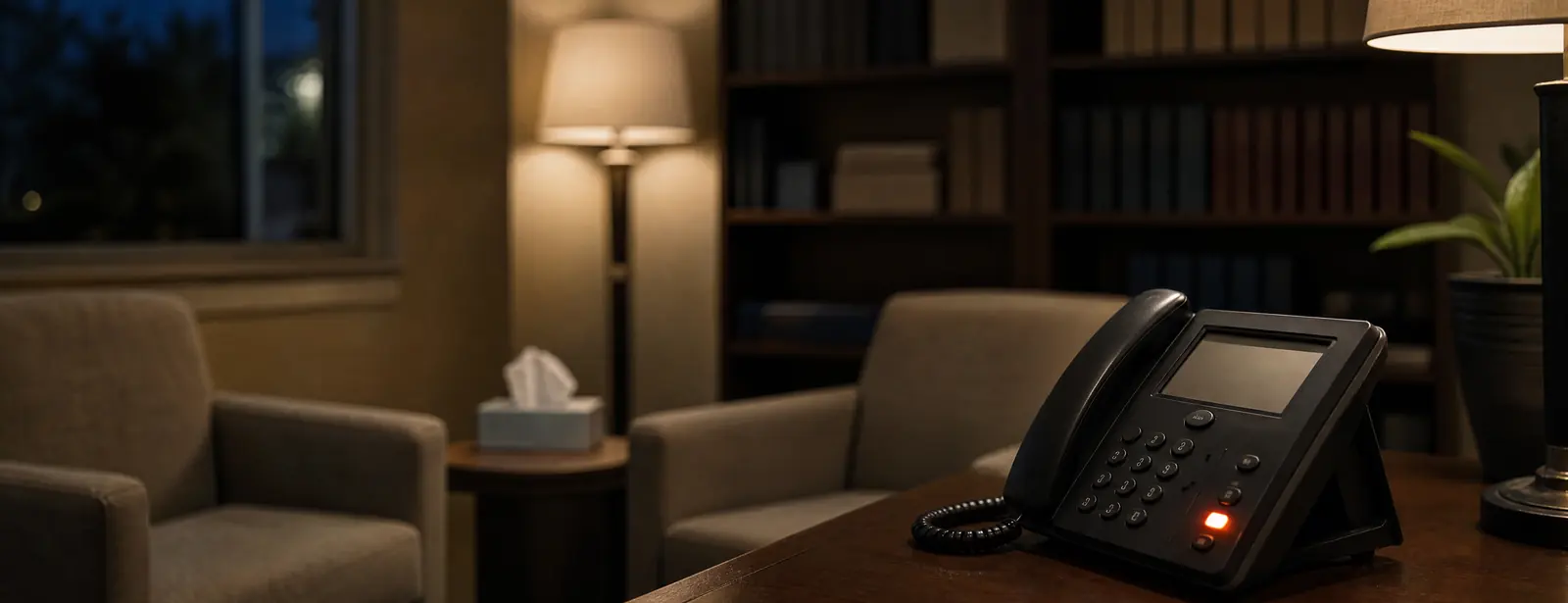
When family law calls come at the wrong time
It’s 10:30 on a Wednesday morning. You’re three hours into a mediation, and the session can’t stop for the phone. Your paralegal is at a hearing for another client.
In the next hour, a father calls because his ex didn’t bring the children back after the weekend. A grandmother asks about visitation. And a woman on her break at work calls to ask about a divorce, from a phone her husband doesn’t check, with about ten minutes to talk.
If that last call goes to voicemail, she won’t leave a message: a message about a divorce is exactly what she can’t risk.
How the call goes
-
Your firm, and a safe moment
It gives the firm’s name, says it’s an AI, and checks whether the caller can talk before asking anything else. If anyone is in danger right now, your 911 line comes first.
The AI says: “Lindqvist Family Law, this is AI Receptionist, the firm’s AI assistant. I can’t give legal advice. Is this a good time to talk?”
-
What kind of matter?
Divorce, custody, support, a protective order, adoption, a change to an order. A sentence is enough.
The AI says: “Is this about a divorce, custody, support, or something else?”
-
The other parent or spouse
Only the full name, for your conflict check. Both sides sometimes call the same firm in the same week, so the name comes before any detail.
The AI says: “What’s the full name of the other person involved, your spouse or the other parent?”
-
Any date or paper
A custody or protective order hearing, divorce papers with a date to respond. Recorded, never explained.
The AI says: “Has a judge set a hearing, or were you handed papers with a date?”
-
How to reach them safely
A safe number, whether a message can be left and when to call go at the top of your summary. Before routing the call, it tells the caller, in your words, that the firm hasn’t taken the matter yet. The question order is in our intake script for law firms.
The AI says: “Is it safe to leave you a message at this number?”

What counts as urgent
For a family law practice, these are the rules we start from. Your rules replace them.
| Situation | What happens |
|---|---|
| The caller, or a child, is in danger right now | “Hang up and call 911” is read first; your urgent attorney is alerted after |
| A child not returned after parenting time, or taken out of state | Attorney on duty now, by your rule |
| Served with a protective order, or a hearing on one inside your urgent window | Urgent: attorney alerted with the date |
| A custody or divorce hearing inside your urgent window | Attorney on duty by phone, or an email that leads with the hearing date |
| Divorce papers served, with a date to respond | Marked urgent with the date served |
| The other party, or their lawyer, calling | Message only, marked; nothing confirmed about anyone |
| Starting a divorce, changing support, adoption, a prenup | Consultation request, booked or taken by your rules |
What it never says on these calls
- Who will get custody, how much support will be or how property will be divided.
- Whether to move out, take the children or stop paying anything.
- That the other spouse or parent has called the firm, or that this caller did, to anyone who asks.
- Anything about fees, retainers or a free first meeting, unless you’ve approved the words.
What you decide
- Your safety line: the words read to a caller in danger, before anything else.
- Consultations: a first appointment in the attorney’s calendar, or a request your team returns from the safe number.
- Your two lines, word for word: no legal advice, and the firm not yet representing the caller.
- Calls from the other side: a message only, or the attorney on that matter.
- Who’s on duty at night and on weekends, for a child not returned on a Sunday.
We set it up the way you want and you approve the final version.
Why this works for family law
Our call protocols come from nearly two decades of running phone reception for small businesses, law offices among them. An answering service for a family law firm fails when it treats this call like any other: a callback to the shared home phone, a message the spouse hears. It asks what matters, so the safe number and the “no messages” rule are on the first line of your summary. It never promises what you don’t, so nobody hears what custody might look like from a phone assistant. More in our method and how it works; other kinds of cases are on the attorney answering service page.
What it costs
Family law answering service pricing here is per answered call, never per minute, so a long, careful first call costs the same as a short one. On Pay As You Go there’s no monthly fee and each answered call is $0.99; a practice with steady first calls usually fits the 50-Call Plan. All plans are on pricing.
Free setup · No contract · Cancel anytime
Your month, by plan
Best fit: 50-Call Plan, $29.00
- Pay As You Go Best fit $29.70
- 50-Call Plan Best fit $29.00
- 100-Call Plan Best fit $49.00
What the month would cost on each plan: the monthly fee plus each call past the ones included.
Questions family law attorneys ask
What does an answering service for family law attorneys do?
It covers your line during court, mediation or after hours, in an order built for family matters: safety, matter, other party, date. The first line of every summary is how to reach the caller safely. If they won’t name the other party, that’s noted and the call still reaches you.
What if both spouses call the firm?
That’s why the other party’s name comes early: your team runs the conflict check before anyone discusses the matter. The AI doesn’t comment on the name it hears, and never tells one spouse the other called.
How does it handle a caller who needs a protective order?
A caller in danger now hears your 911 line first. Otherwise it records any hearing date, or an order already served, and marks the call urgent by your rule. It never explains how to get an order or what one covers.
Will it ever leave a message or text a caller who said no?
No. “Safe to leave a message?” is part of every first call, and the answer sits at the top of your summary. A text tied to the call, such as your office address, goes only if the caller says it’s safe to receive one.
Can parents call in Spanish?
Yes, on the same number, with your protocol written in Spanish. The safety line and “is this a good time to talk?” are in Spanish too, so nobody switches languages to say no. Details on bilingual AI receptionist and in our Spanish-speaking caller protocol; legal intake shows how first calls become consultations.
A safe first call, every time
Press Get started and the first thing we ask for is your safety line, then your practice areas and what’s urgent. We draft the protocol around it, and nothing is forwarded until you’ve approved every word.
Free setup · No contract · Cancel anytime