
Industries
Automotive answering service for auto repair shops
Short answer
An automotive answering service answers your shop’s phone while your hands are under a car. Ours is a 100% AI receptionist: it tells callers it’s an AI, books jobs into your open bays, takes “is my car ready?” calls for your service writer and gets a driver stuck on the roadside to you, by your rules. It never diagnoses a car or quotes a repair you haven’t priced, and you get a summary of every call.
Free setup · No contract · Cancel anytime
Example call: brakes grinding on the way home
Calloway Auto Works · Brakes grinding on the way home
- AI
- Calloway Auto Works, this is AI Receptionist, the shop’s AI assistant. How can I help?
- Caller
- My brakes started grinding on the way home.
- AI
- What’s the year, make and model?
- Caller
- A 2017 Honda Civic.
- AI
- Our first opening is Monday at 7:30 a.m. Shall I book it?
- Caller
- Yes, please.
- AI
- Your name and best number?
- Caller
- Anjali Venkataraman, 555-0185.
- AI
- You’re booked for Monday at 7:30, Anjali. I’ll text you our address.
Summary sent to you
- Booked
- Monday 7:30 a.m., 2017 Honda Civic, brakes grinding since today.
- Caller
- Anjali Venkataraman, 555-0185. Address sent by text.
- Done
- appointment saved. No diagnosis or price given.
When shop calls come at the wrong time
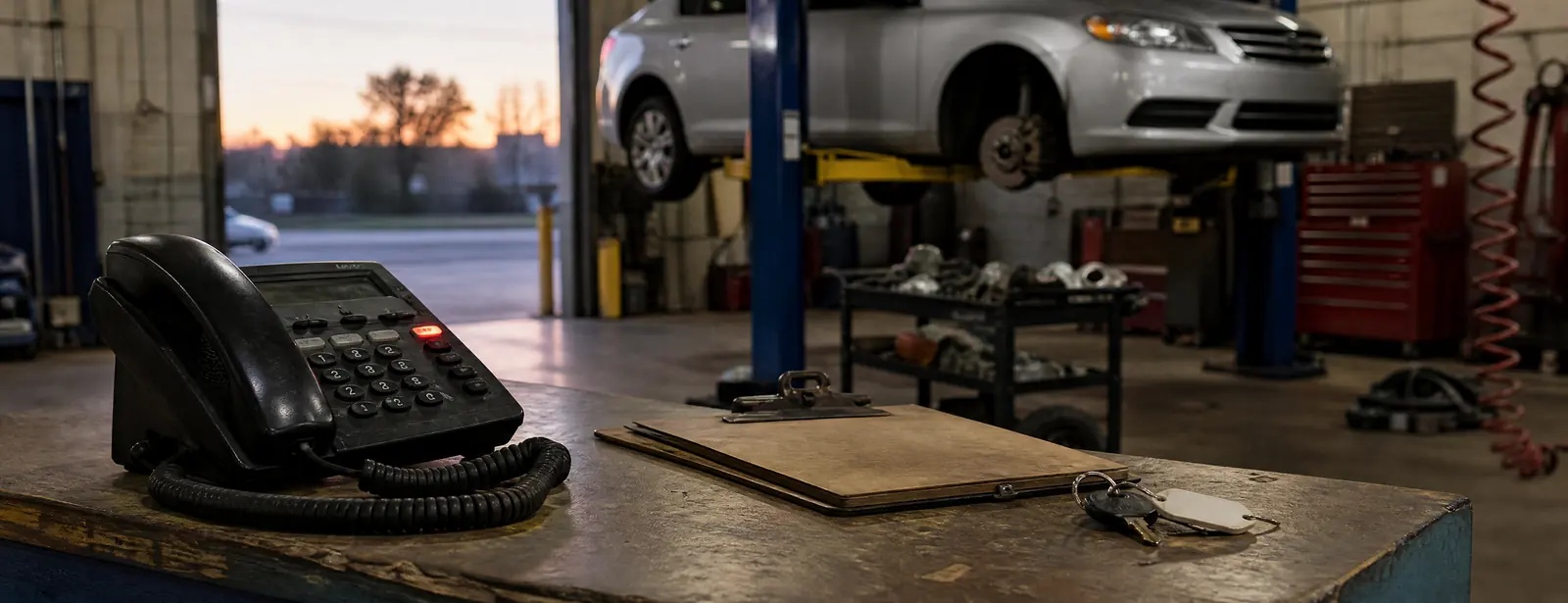
It’s 4:40 on a Friday in Dayton. Both lifts are full, you’re under a Silverado with a torque wrench, and the service writer is at the counter with a customer disputing a bill. The phone rings: someone whose brakes started grinding on the way home. Then a customer asking if her SUV is ready. Then a driver whose car died at an intersection. By the time anyone wipes their hands, two of them have called the shop down the road, and the third left no message.
How the call goes
-
Safe first, if the car is on the road
If the caller is stuck in traffic or on the shoulder, the AI reads your safety line before anything else, then gives your towing partner’s number if you have one.
The AI says: “If you can, move away from traffic. If anyone is hurt or in danger, please call 911.”
-
What kind of call
A new job, a car already in the shop, a question about a bill or a decision on extra work. Each goes a different way.
The AI says: “Is this about booking a repair, or about a car that’s already with us?”
-
The car and what it’s doing
Year, make and model, and the problem in the customer’s words. It writes it down; it doesn’t interpret it.
The AI says: “What’s the year, make and model, and what is the car doing?”
-
Book, or pass to the service writer
New work goes into the first slot your calendar allows, confirmed only once it’s saved. Status questions and approvals for extra work go to your service writer as a message, or as a transfer if you want them put through.
The AI says: “I can bring it in Monday at 7:30 a.m. Does that work?”
-
Name, number and the address
It repeats the number back and, if the caller asks, can text them the shop’s address.
The AI says: “I’ll text you our address. Is this the best number for that?”

Your shop’s protocol is built from the questions above and from our after-hours triage protocol, which sorts a night call into now, the morning or a message. The full call protocol library shows how other trades read.
What counts as urgent
For an independent repair shop, this is where we start. You decide the final list.
| Situation | What happens |
|---|---|
| Car broken down on the road | Your safety line and your tow partner’s number if you have one; the shop alerted now or at opening, by your rule |
| Customer approving or declining extra work on a car on your lift | Put through to the service writer, or a priority message |
| Car released and it’s doing the same thing again | Priority callback from the service writer |
| Brakes, steering or a warning light, car still driving | Earliest slot offered; your safety line read if you’ve approved one |
| “Is my car ready?” | Message for the service writer with the name and vehicle |
| Oil change, tires, inspection, a quote request | Booked, with your approved prices if you have them |
What it never says on these calls
- A diagnosis, such as “that sounds like your alternator.”
- A price for a repair you haven’t priced, or an estimate over the phone.
- That the car is safe to drive, or that it can wait.
- A time the car will be ready, unless your service writer confirmed it.
- That extra work is approved. Only the customer can approve it, and your service writer confirms it with them.
What you decide
- Your calendar: which jobs it books and how many drop-offs a morning can take.
- Your safety and towing lines: the exact words for a car on the road, and your tow partner’s number.
- Prices it can say: only fixed-price services you list, such as an oil change or a state inspection.
- Who gets what: status calls and approvals to the service writer, warranty or billing to the owner.
- When it puts a call through: comebacks, approvals or every customer with a car on your lift.
- Spanish: customers can speak Spanish with the AI on the same line.
We set it up the way you want and you approve the final version.
Why this works for auto repair shops
Our call protocols come from nearly two decades of running phone reception for small businesses. A repair shop lives on two things the phone can wreck: trust and bay time. It never promises what you don’t: a guessed diagnosis or a price said on the phone becomes an argument at the counter. It knows when to hand over: an approval for extra work is a conversation for your service writer, not a form. The rest is on our method, and how calls reach the counter is on call transfer.
What it costs
Start with no monthly fee on Pay As You Go, at $0.99 per answered call. A busy shop usually does better on the 50-Call Plan, 50 calls for $29 a month, or the 100-Call Plan. A ten-minute status call costs the same as a short one. All plans are on pricing.
Free setup · No contract · Cancel anytime
Your month, by plan
Best fit: 50-Call Plan, $29.00
- Pay As You Go Best fit $29.70
- 50-Call Plan Best fit $29.00
- 100-Call Plan Best fit $49.00
What the month would cost on each plan: the monthly fee plus each call past the ones included.
Questions auto repair shop owners ask
What does an auto repair AI receptionist actually do?
The same as a good automotive answering service: it answers every call to your shop, books new jobs, takes status and approval calls for your service writer and gives stranded drivers your safety line and towing number. Sales calls are filtered out, and you get a summary of each call by email.
Can it tell customers if their car is ready?
No. It takes the name and the vehicle and passes the question to your service writer, who knows where the car really is. The customer hears that the service writer has the question, not a guessed time. If you’d rather have status calls put through to the counter, that’s a rule you set.
Will it quote prices for repairs?
Only the fixed prices you give it, such as an oil change or an inspection. Anything that depends on looking at the car gets “we’ll need to see it first” and a booking. That keeps your estimates where they belong: in the shop, in writing.
Does it work for a dealership’s service line?
For a dealership’s service department, yes. Dealership AI phone answering there means bookings, status messages and transfers to service advisors, with sales inquiries taken as leads for your sales team. It works from your hours and your calendar, not a general script.
What happens to calls at night?
A driver whose car breaks down at 10 p.m. gets your safety line and your tow partner’s number. Whether that call wakes you or waits in your inbox until morning is your rule; booking requests always wait in your calendar. If you work with a tow company, see the answering service for towing companies, and other trades on industries.
Put your shop’s phone on the AI receptionist
“Get started” asks for your hours, your bays and what your service writer needs from every call. From that we write your shop’s protocol, free, and your number is only forwarded once you’ve signed off on it, as how it works explains.
Free setup · No contract · Cancel anytime