
Industries
Attorney answering service: your firm’s calls, answered by AI
Short answer
An attorney answering service picks up your firm’s calls when nobody in the office can. Ours is 100% AI: it answers in your firm’s name, tells callers it’s an AI assistant, takes a new client’s details and the name of the other party for your conflict check, and puts urgent calls, like an arrest or a hearing this week, through to the attorney on duty. It never gives legal advice, and you get a written summary of every call.
Free setup · No contract · Cancel anytime
Example call: served with a lawsuit at lunch
Whitcombe and Arroyo Law · Served with a lawsuit at lunch
- AI
- Whitcombe and Arroyo Law, this is AI Receptionist, the firm’s AI assistant. I can’t give legal advice, but I can take your details.
- Caller
- I just got served. Granite Point Supply is suing my company.
- AI
- When were you served?
- Caller
- Today, at lunch.
- AI
- Your name and best number?
- Caller
- Kevin Mahler, 555-0133.
- AI
- Thanks, Kevin. Papers served today are on the firm’s urgent list, so I’m emailing an attorney now. That doesn’t mean the firm has taken your case.
Summary sent to you
- New matter, urgent
- lawsuit served today against the caller’s company. Plaintiff: Granite Point Supply (for conflict check).
- Caller
- Kevin Mahler, 555-0133.
- Done
- attorney on duty emailed. No advice given. Caller heard that this doesn’t mean the firm has taken the case.
When law firm calls come at the wrong time
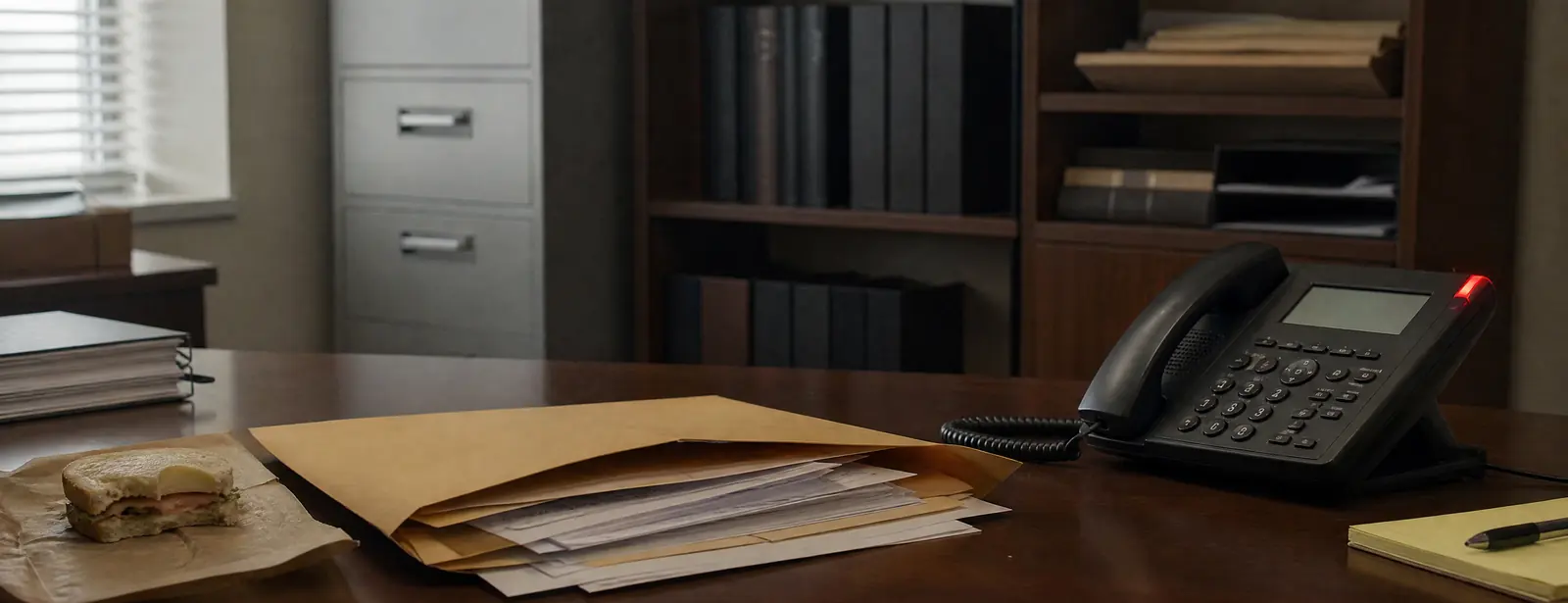
It’s 2:50 on a Tuesday afternoon. Both partners are across town in a deposition, phones face down on the conference table. The paralegal is at the courthouse filing a motion, and the front desk is empty.
In twenty minutes the phone rings four times: a client asking if Thursday’s hearing is still on, a copier salesman, a court clerk with a scheduling order, and a business owner served with a lawsuit at lunch. Three of those calls get a message or reach the right person. The fourth is a new client calling every firm nearby, and it will try the next one on the list.
How the call goes
-
Your firm’s name, and what it can’t do
The legal advice line comes before the story does.
The AI says: “Whitcombe and Arroyo Law, this is AI Receptionist, the firm’s AI assistant. I’ll pass your details to an attorney, though I can’t give legal advice.”
-
Client, new caller, or someone else?
Clients go to their attorney or leave a message; new callers continue. Opposing counsel, the court or a vendor skip intake and leave a message.
The AI says: “Are you a client of the firm, or is this about something new?”
-
What it’s about, and who’s on the other side
The matter in a sentence, sorted into your practice areas, and the other side’s name, labeled for your conflict check.
The AI says: “Who’s suing, or who’s on the other side? I’ll pass the name along so the firm can check for conflicts.”
-
Any date that changes the urgency
A hearing, a deadline to respond, or the day papers were served, written down as said and never explained.
The AI says: “Do you have a court date, or a date on the papers you received?”
-
Contact, your line, and the hand-off
Name, best number, and whether a voicemail there is safe. Then your line about not having taken the matter, and a transfer, an alert or a consultation request. Every question, in order, is on the legal intake script we start from.
The AI says: “I’m alerting an attorney now. This call doesn’t mean the firm has taken your case.”

What counts as urgent
For a small firm, these are the rules we start from. Your rules replace them.
| Situation | What happens |
|---|---|
| A caller who says they or someone with them is in danger right now | They hear “hang up and call 911” first; the attorney you named for urgent calls is alerted after |
| A family member just arrested, or police asking someone to come in | Straight to the attorney on duty if criminal work is in your practice; if not, the referral line you approved |
| A hearing or a deadline to respond inside your urgent window | The attorney on duty gets the call, or an email right away with the date |
| Papers served today: a lawsuit, an eviction, a protective order | Marked urgent with the date served, by your rule |
| Opposing counsel or a court clerk | Message to the attorney on that matter, marked; nothing agreed on the firm’s behalf |
| An existing client with a question about their case | Put through to their attorney, or a message for them |
| A new matter with no date attached | Consultation request, booked or taken by your rules |
Practice areas
Each practice area gets its own calls, urgent list and lines. The last two pages are about how your firm is set up: an intake team, or a solo attorney with no staff.
-
Criminal defense
“What’s the full name and date of birth of the person who was arrested?”
An arrest at midnight: where the person is held, the next court date, and a line about not discussing the facts by phone
-
Family law
“Is this about a divorce, custody, support, or something else?”
Safety first, a discreet number, and protective order or custody dates
-
Immigration
“No puedo dar consejo legal, pero tomo sus datos para el abogado. ¿Qué ha pasado?”
Calls in English or Spanish, a detained relative, dates on a notice, and no questions about status
-
Personal injury
“When did the accident happen?”
The accident date, whether anyone was treated, and an insurer asking for a statement
-
Legal intake
“Are you still working there, or when did your job end?”
The whole intake process, from first call to consultation, for firms with an intake team
-
Solo attorneys
“I can’t agree to any change, but I’ll pass it on. What date are you proposing?”
One attorney in court all morning: who can interrupt, and who waits for the afternoon
Other businesses we answer for are on the industries index.
What it never says on these calls
- Any legal advice, including what to do about papers already served.
- Whether a lawsuit has merit, what it could cost the caller or how it ends.
- That the firm has taken the matter, or that this call makes anyone a client.
- Who the firm represents. It won’t confirm or deny that to anyone else.
- A fee, or “free consultation,” unless you’ve approved the words.
What you decide
- Your practice areas, and the referral line for callers outside them.
- Your urgent window: how close a hearing or deadline must be to interrupt an attorney.
- Who’s on duty, who backs them up, and when it’s a cell phone instead of an email.
- Two lines in your words: legal advice, and the firm not having taken the matter.
- Consultations: straight into an attorney’s calendar, or a request your team calls back. More on appointment scheduling.
We set it up the way you want and you approve the final version.
Why this works for law firms
Our call protocols come from nearly two decades of running phone reception for small businesses, law offices among them. A phone answering service for lawyers hurts a firm in two ways: a caller hears something no attorney signed off on, or the served lawsuit waits behind the copier salesman until Monday. It never promises what you don’t: “do I have a case?” gets “an attorney will review it.” It knows when to hand over, so the lawsuit reaches an attorney today and the salesman reaches nobody. More on our method and how it works.
What it costs
There’s no monthly fee on Pay As You Go: $0.99 per answered call, a new client at 2 p.m. or an arrest call at 2 a.m. A firm taking new matters every week usually does better on the 50-Call Plan or the 100-Call Plan, where a block of calls comes with the monthly fee. Every plan is on pricing.
Free setup · No contract · Cancel anytime
Your month, by plan
Best fit: 50-Call Plan, $29.00
- Pay As You Go Best fit $29.70
- 50-Call Plan Best fit $29.00
- 100-Call Plan Best fit $49.00
What the month would cost on each plan: the monthly fee plus each call past the ones included.
Questions law firms ask
What is an attorney answering service?
It picks up when the attorneys and staff can’t, and works through your rules in a fixed order: danger, client or new caller, matter, other party, date. The summary puts the urgent part on top, and anything the caller didn’t know is marked as not given, never guessed.
How is an AI receptionist for law firms different from a lawyer answering service with people?
Both answer in your firm’s name and take intake details. The AI picks up every call at once, day and night, and bills per answered call, not per minute. People handle a conversation that wanders off script better; the AI follows your protocol and hands over the rest.
Is a virtual receptionist for lawyers safe for confidential calls?
It asks for as little as possible: the matter in a sentence, the other party’s name and any date. Summaries go only to the addresses your firm sets. How recordings are stored and who can see them is on security and privacy.
What if the caller doesn’t know what kind of lawyer they need?
Most don’t. It asks what happened in a sentence or two and sorts the matter into your practice areas. If it fits none, the caller hears your referral line, if you’ve approved one, and the summary says why. It never tells anyone what kind of case they have.
Do you offer a bilingual legal answering service?
Yes. The same line answers in English and Spanish, with your protocol written in both, and nobody presses a key. It matters most in immigration and family law, where the first call often comes from a relative. See bilingual AI receptionist and the Spanish-speaking caller protocol.
Every new matter, to the right attorney
Press Get started and tell us your practice areas, who’s on duty and what’s urgent for your firm. We draft the protocol for your legal phone answering service, and nothing goes live until you’ve approved every line.
Free setup · No contract · Cancel anytime