
Industries
Answering service for towing companies, 24/7
Short answer
An answering service for a towing company has to get three things right before anything else: is everyone safe, where exactly is the car, and can it roll. AIReceptionistGo is a 100% AI receptionist that answers in your company’s name, says it’s an AI, tells callers in danger to call 911, takes the exact location and vehicle details, and puts the call through to your driver on duty. Each job also reaches you in writing, location first.
Free setup · No contract · Cancel anytime
Example call: a pickup stranded on the highway
Caprock Towing · A pickup stranded on the highway
Urgent
- AI
- Caprock Towing, this is AI Receptionist, the AI assistant. Is anyone hurt, and are you out of traffic?
- Caller
- Nobody’s hurt. I’m on the shoulder of Highway 84.
- AI
- Which direction, and the nearest mile marker?
- Caller
- Eastbound, just past mile marker 12.
- AI
- What’s the vehicle, and do the wheels roll?
- Caller
- Gray pickup, flat tire, bent rim. It rolls.
- AI
- Your name and number?
- Caller
- Tyrell Gaines, 555-0194.
- AI
- Thanks, Tyrell. I’m putting you through to our driver on duty.
Summary sent to you
- Urgent
- gray pickup on the shoulder, Highway 84 eastbound past mile marker 12. Flat tire, bent rim, wheels roll.
- Caller
- Tyrell Gaines, 555-0194. Nobody hurt, out of traffic.
- Done
- transferred to the driver on duty. No arrival time or price given.
When towing calls come at the wrong time
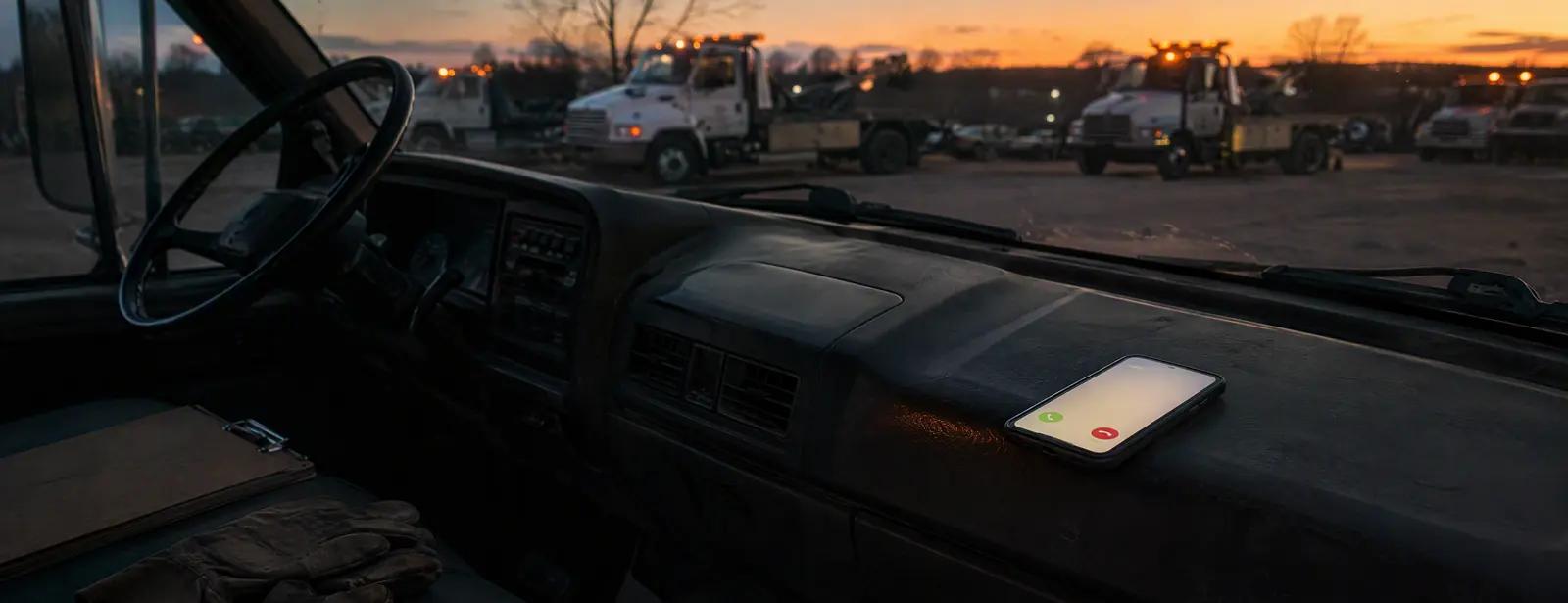
It’s 11:40 on a Friday night outside Lubbock. You’re on the shoulder of the interstate with your hazards on, gloves on, chaining a sedan to the flatbed while trucks go past at seventy. Your phone is ringing in the cab.
It’s a driver stranded on the highway with a blown tire. Ten minutes later it’s someone whose car was towed from an apartment lot, asking where it is. Then a deputy with an accident scene. You can’t take any of them with your hands on a chain.
How the call goes
-
Safety first
Is anyone hurt? Is the car in a traffic lane? Any smoke or fire? Is a child or a pet locked inside? Any yes: the caller is told to call 911 first, then your driver is alerted. If you approve a road-safety line, the AI reads it word for word.
The AI says: “Is anyone hurt, and are you somewhere safe, out of traffic?”
-
Where exactly
Road or highway, direction of travel, nearest mile marker or exit, or the cross streets. On a highway, “near the exit” isn’t enough for your driver to find them at night.
The AI says: “Which direction are you headed, and what’s the nearest mile marker or exit?”
-
The vehicle, and whether it rolls
Make, model and color, what happened, and whether the wheels turn. That tells your driver which truck and equipment to bring.
The AI says: “What’s the vehicle, and do the wheels still roll?”
-
Where it’s going
A repair shop, home, or your yard. Whether they’re calling through a roadside plan, if you want it asked. When the call is going straight through to your driver, it can leave this one for them.
The AI says: “Where would you like the vehicle taken?”
-
Put it through
Urgent calls go straight to your driver on duty, or they’re emailed at once with the location first. Scheduled tows are booked or taken as requests.
The AI says: “I’m putting you through to our driver on duty now.”

Night calls run inside our after-hours triage protocol; more examples are in the call protocol library.
What counts as urgent
For a towing and recovery company, this is the list we start from. Your dispatch rules, your service area and your police rotation replace it.
| Situation | What happens |
|---|---|
| Someone hurt, a car in a traffic lane, smoke or fire | Told to call 911 first; driver on duty alerted |
| A child or a pet locked in a car | Told to call 911 first; driver on duty alerted |
| Police or a motor club calling with a job | Put through now, always |
| A driver stranded on a highway shoulder | Driver on duty reached now |
| Off the road, in a ditch or a parking garage, nobody at risk | Driver on duty, or the next open slot, by your rules |
| “Where’s my car?” after a private-property tow | Your yard address, hours and what to bring; message if they dispute it |
| A dead car to move tomorrow, or a transport quote | Booked, or a message for the office |
What it never says on these calls
- An arrival time, such as “a truck will be there in 20 minutes.” It can’t see where your trucks are.
- A price, a hook-up fee or a mileage rate you haven’t approved.
- Whether a roadside plan or insurance will cover the tow.
- Whether the car is safe to drive, or how to fix it.
- Anything that sounds like “you don’t need to call 911.” It’s a phone line for your business, not an emergency service.
What you decide
- Your service area, including which highways and how far out you go at night.
- Your safety lines: the exact words for someone on a shoulder or in traffic.
- Who’s on duty, with a backup, and whether they get the call or an email with the location.
- Police, motor club and account calls: always put through, or to a separate number.
- Impound and private-property tows: yard address, hours, what to bring.
- Prices: quoted only if you approve them, or never.
We set it up the way you want and you approve the final version.
Why this works for towing companies
Our call protocols come from nearly two decades of running phone reception for small businesses, and night calls from the side of a road are some of the most urgent we handle. It escalates real emergencies: danger goes to 911 first, and a stranded driver reaches your truck, not your voicemail. It asks what matters: the exact location before the name, because that’s what your driver needs first. Rotations and backups for night calls are on the on call answering service page; the method itself is on our method.
What it costs
You pay per answered call, not per truck or per driver: $0.99 each on Pay As You Go, with no monthly fee and nothing extra after dark, when most of your jobs come in. If you run several trucks and the phone rarely stops, the 50-Call Plan covers 50 calls for $29 a month. See pricing.
Free setup · No contract · Cancel anytime
Your month, by plan
Best fit: 50-Call Plan, $29.00
- Pay As You Go Best fit $29.70
- 50-Call Plan Best fit $29.00
- 100-Call Plan Best fit $49.00
What the month would cost on each plan: the monthly fee plus each call past the ones included.
Questions towing company owners ask
What does an answering service for a towing company do?
It answers every call when you’re on a job or asleep. It checks for danger first, takes the exact location, the vehicle and where it’s going, and puts urgent calls through to your driver on duty. Scheduled tows are booked or taken as requests, and every call is written up for you with the location at the top.
Is it a towing dispatch answering service?
It’s the answering side of dispatch. It takes every call and gets the details right, then hands the job to you or your dispatcher, by putting the call through or emailing it at once. It doesn’t assign trucks or track them. Your team still decides who goes.
What does it tell someone stuck in traffic?
To call 911 first if anyone is hurt or the car is in a traffic lane. If you’ve approved a safety line, such as staying in the vehicle with the seatbelt on, it reads it exactly as written. It never gives advice of its own and never tells anyone not to call 911.
Can it handle “where’s my car?” calls after a private-property tow?
Yes. It gives your yard address, hours and what the owner needs to bring, from the information you approve. If the caller disputes the tow, it takes a message for you without arguing or explaining the rules. Those calls stop interrupting your drivers.
Can it answer in Spanish?
Yes, on the same line and without pressing a key. A stranded driver who speaks Spanish gets the same safety questions, in Spanish. See the bilingual AI receptionist. Cab and limo companies use our taxi call answering service; all sectors are on industries.
Stay on the job, not the phone
Get started asks for your service area, who’s on duty and your safety lines, and we build your towing answering service protocol at no cost to set up. You approve it before you forward your number, following how it works.
Free setup · No contract · Cancel anytime