
Industries
Answering service for hotels, inns and B&Bs
Short answer
An answering service for hotels takes the calls your front desk can’t: at night, during check-in rushes and when the innkeeper is upstairs with a guest. Ours is a 100% AI receptionist that tells callers it’s an AI, takes reservation requests, tells your team at once when a guest will arrive late and alerts your night manager when a guest needs help. It never confirms a booking that isn’t saved, it answers in English and Spanish, and you get a summary of every call.
Free setup · No contract · Cancel anytime
Example call: a late arrival after a delayed flight
The Larkspur Inn · A late arrival after a delayed flight
Urgent
- AI
- The Larkspur Inn, this is AI Receptionist, the inn’s AI assistant. How can I help?
- Caller
- My flight’s delayed. I won’t get there until about 1 a.m.
- AI
- I’m letting the front desk know you’ll be late. The name on the reservation?
- Caller
- Benedikt Osei, two nights.
- AI
- And a number to reach you?
- Caller
- 555-0199.
- AI
- Thank you, Benedikt. I’ve alerted our night manager just now, with your number and arrival time.
Summary sent to you
- Urgent
- late arrival tonight, about 1 a.m., flight delayed. Hold per your policy.
- Guest
- Benedikt Osei, two-night reservation, 555-0199.
- Done
- night manager alerted with the arrival time. Guest not told the room is held. No door codes given.
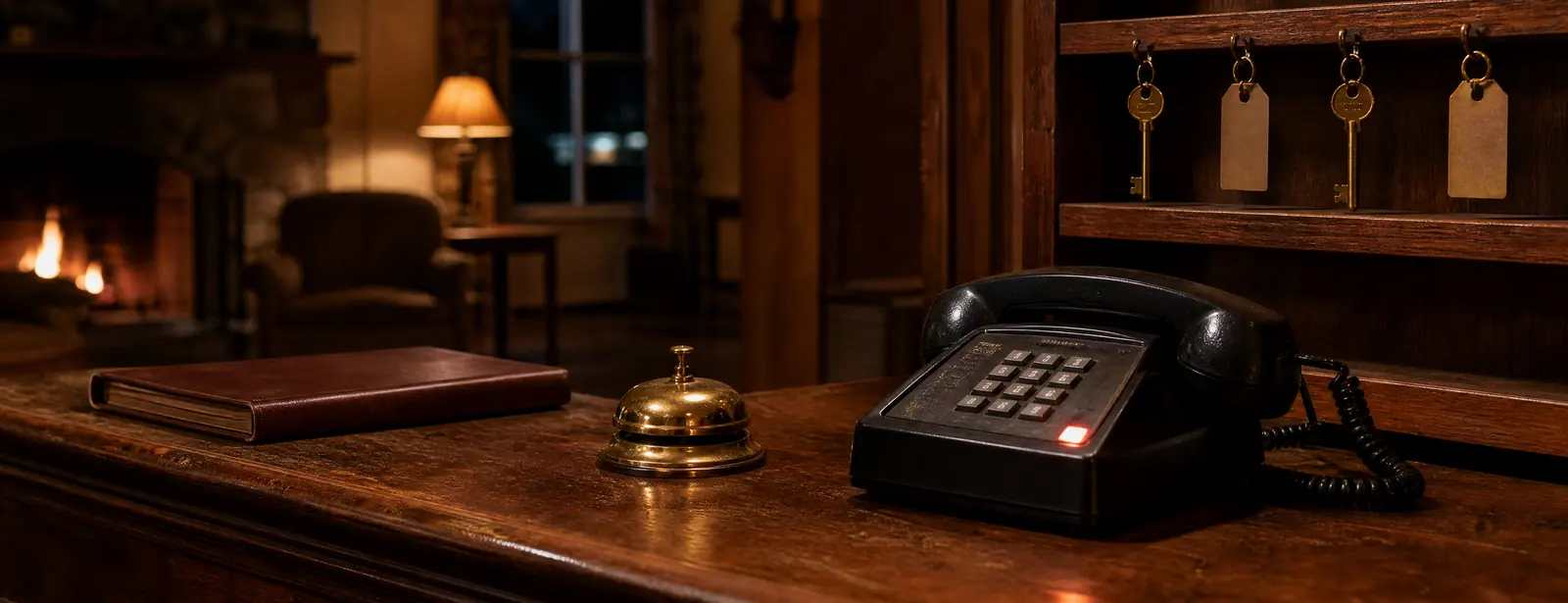
When hotel calls come at the wrong time
It’s 11:40 p.m. at a twelve-room inn in Savannah. The owner has done the last walk-through, locked the front door and gone home. The phone keeps ringing anyway. A couple in Germany wants to book a weekend in March, and it’s morning for them. A guest in room 7 says the hot water is gone. A traveler stuck at the airport wants to know if her room will still be there at 1 a.m. And someone asks whether his business partner is staying at the inn. Each call needs a different answer, and one needs no answer at all.
How the call goes
-
Staying, arriving or booking
The first question decides the path: a guest in the building, a guest on the way, or someone who wants to book.
The AI says: “Are you staying with us tonight, arriving soon, or looking to make a reservation?”
-
For a guest in the building: what’s wrong
Locked out, something broken in the room, a noise problem or a safety issue. If anyone is hurt or there’s smoke or fire, it reads your safety line first.
The AI says: “If anyone is in danger, please call 911 now; I’m alerting our manager as well. Otherwise, tell me what’s happening and I’ll get them.”
-
For a guest on the way: the late arrival
A late arrival is noted for your team at once, so they can hold the room by your policy instead of releasing it as a no-show.
The AI says: “What’s the name on the reservation, and about what time will you arrive?”
-
For a new booking: dates, guests and the room
Dates, number of guests and the room type. Rates come only from the list you approve. If your protocol lets it check and save bookings, it books; otherwise it takes the request and your team confirms.
The AI says: “Which dates are you looking at, and how many guests?”
-
Name and number, and the next step
It repeats the details back and says exactly what happens next, with no promise it can’t keep.
The AI says: “I’ve sent your request to the front desk. Nothing is booked until they confirm it.”

An inn’s protocol is built from the questions above and from our after-hours triage protocol, which decides what wakes your night manager and what waits for the morning desk. Other examples are in the call protocol library.
What counts as urgent
For a small hotel or inn, these are the rules we start from. You set the final list.
| Situation | What happens |
|---|---|
| Fire, smoke, an injury or a guest in danger | Your 911 line first, then the manager on call alerted now |
| Guest locked out of the room or the building | Urgent: manager on call put through |
| Leak, no heat, no hot water or no power in a room | Urgent: manager or maintenance alerted, by your rules |
| Late arrival on a reservation for tonight | Front desk alerted now so the room is held per your policy |
| Noise or a problem with another guest | Manager alerted, or a message, as you choose |
| Reservation request, changes or cancellations | Booked if your protocol allows it, or a request for your team |
| Check-in times, parking, pets, directions | Answered from your protocol |
What it never says on these calls
- Whether someone is staying at your hotel, or any guest’s room number.
- That a reservation is confirmed, unless it’s saved in your booking system.
- A rate, upgrade or discount you haven’t approved.
- That a cancellation fee is waived.
- A request for card numbers over the phone. Payment stays with your booking system.
What you decide
- Who’s on call at night: the manager, the owner or maintenance, and a backup.
- Your urgent list: lockouts, room problems, safety and late arrivals.
- Reservations: whether it books directly or takes requests, and which rates it can say.
- Your policies: check-in and check-out, cancellations, pets and parking, read as written.
- Late check-in: what it tells a guest arriving after the desk closes, and whether it can say the room is held.
- Languages: guests can speak English or Spanish on the same line; see how a Spanish-speaking caller is handled.
We set it up the way you want and you approve the final version.
Why this works for hotels
Our call protocols come from nearly two decades of running phone reception for small businesses, and a hotel answering service has to follow the rules every good front desk learns on day one. It never promises what you don’t: no confirmation until the booking is saved, no rate you didn’t approve, and never a word about who is staying in the building. It escalates real emergencies: a guest locked out at midnight reaches your manager, not a voicemail. More on our method, and on answering in two languages on the bilingual AI receptionist page.
What it costs
A call costs the same at noon or after the desk closes. With no monthly fee on Pay As You Go, you pay $0.99 per answered call. A small inn usually fits the 50-Call Plan, 50 calls for $29 a month; a busier hotel, the 100-Call Plan. All plans are on pricing.
Free setup · No contract · Cancel anytime
Your month, by plan
Best fit: 50-Call Plan, $29.00
- Pay As You Go Best fit $29.70
- 50-Call Plan Best fit $29.00
- 100-Call Plan Best fit $49.00
What the month would cost on each plan: the monthly fee plus each call past the ones included.
Questions hotel owners ask
Is this a chatbot for hotel booking?
No. A booking chatbot lives on your website. This is an answering service for hotels. It answers your phone line, by voice, for guests who would rather call: it takes reservation requests, answers questions about the property and reaches your staff when a guest needs help. It works alongside whatever booking tools you already use.
Can it take reservations?
If your protocol gives it a way to check availability and save a booking, yes, and it confirms only once the booking is saved. Otherwise it takes the dates, guests and contact details as a request, tells the caller nothing is booked until your team confirms, and sends it to you at once.
How does it handle a guest who’s locked out at night?
It asks whether they’re out of the room or the building, takes the name and room, and puts the call through to your manager on call. If that person doesn’t answer, it tries your backup and keeps the alert in their inbox, and tells the guest someone is being reached.
Can it replace a night auditor?
No, and it doesn’t try to. It answers the phone; the audit, the cash drawer and the guest at the desk stay with your night staff. It’s the phone part of AI automation for hotel front desk operations: calls answered, sorted and passed on, while the work at the desk stays with your team.
Does it work for B&Bs and vacation rentals?
Yes. Small properties with no one at a desk use it most: a B&B owner asleep upstairs, a vacation rental manager with six houses and one phone. The protocol is the same; what changes is who’s on call and how late check-in works. Restaurants that share a building with an inn are on the restaurant answering service page, and other businesses on industries.
Answer every guest, even after the desk closes
Tell us who’s on call at night, how late check-in works and the questions your guests ask most. We set up your property’s protocol for free, you approve it, and then you forward the front desk line; the details are on how it works.
Free setup · No contract · Cancel anytime